
Abstract
Childhood obesity remains a major public health concern in the United States and, specifically, in Washoe County, Nevada. Parents’ attitudes toward their children’s lifestyle and diet are crucial in the battle against childhood obesity. The goal of this obesity prevention program is to lower the obesity rate in Washoe County by educating parents of children aged 8–12.
The theory of planned behavior has informed this program and its two components. The program’s first component will include four in-person individual therapy sessions with children. Two instructional workshops utilizing motivational interviewing techniques will be conducted for participating families. The second component, consisting of both online and in-person components, will assist parents in determining their child’s weight status using body image scales.
Program Rationale
In the United States, childhood obesity is still a grave and urging public health issue. According to the CDC, 19.7% of children and adolescents in the US were impacted, translating to almost 14.7 million people (Centers for Disease Control and Prevention, 2022). The prevalence of obesity disturbingly varies across demographic groups, revealing widespread disparities. For Hispanic and non-Hispanic Black children, the obesity rates are above 24%, while for non-Hispanic White children, this number is 16.6%, so the former children suffer a disproportional burden in comparison to the latter (Centers for Disease Control and Prevention, 2022).
Socioeconomic disparities point out that these statistics reveal not only a health problem but also an equity issue. Obesity prevalence nearly doubles in children from lower-income households compared to those in the highest income bracket, putting them at higher risk (Centers for Disease Control and Prevention, 2022). The inequality is also remarkable among race- and gender-based subgroups, as non-Hispanic Black girls demonstrate no variation in terms of income level.
These national trends are manifested locally in Nevada’s Washoe County, where regional data exhibit a dangerous trajectory. As Nevadan children get older, their obesity rates are also rising, which is consistent with national indicators (Lombardo et al., 2022). Just 28.9% of male and 17.2% of female high school students engage in physical exercise for the prescribed minimum of 60 minutes per day, thus failing to reach recommended levels of physical activity (Student Weight status, 2022, p. 1).
Moreover, there are still ethnicity disparities between Black and Hispanic students and their White and Asian counterparts (Lombardo et al., 2022). There is also present a gender factor; more female than male students fall within the healthy weight range (Student Weight Status, 2022). The difference between Title 1 and non-Title 1 schools is especially distressing (Student Weight Status, 2022). It can be said that the childhood obesity situation in Washoe County is consistent with the rest of the country.
It is commonly known that childhood obesity has serious long-term health effects. Such effects include an increased risk of chronic diseases (such as multiple sclerosis) and a shortened life expectancy, as well as immediate health problems such as diabetes and high blood pressure (Harroud et al., 2021; Li et al., 2023; Sahoo, 2015). This urgent issue necessitates targeted interventions in Washoe County to mitigate the adverse outcomes associated with childhood obesity and ensure a healthier future for the community’s youth.
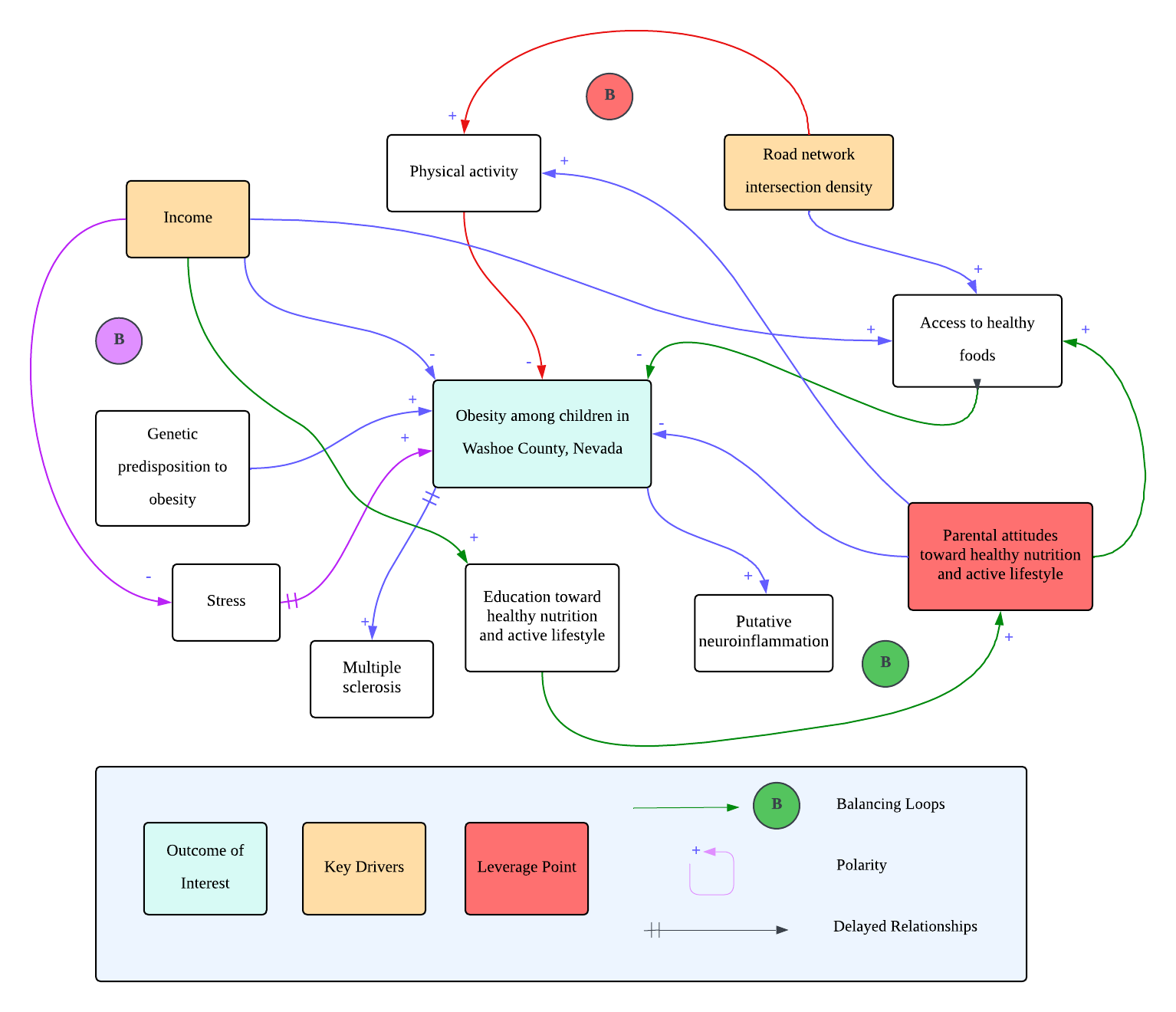
Parental attitudes toward a healthy diet and active lifestyle are critical in the Washoe County community’s fight against childhood obesity. According to Romanelli et al. (2020), parental attitudes, beliefs, and actions regarding what to eat and how much exercise to get are essential factors in the development of childhood obesity. Parents are their children’s first teachers and guardians regarding opportunities for physical exercise and access to wholesome foods (Romanelli et al., 2020).
In a study by García-Blanco et al. (2022), parents who underestimated their child’s weight were 3.35 times more likely to hold unhealthy views toward their child’s eating habits. Brown et al. (2015) stated that interventions aimed at changing parental attitudes and behaviors can significantly reduce childhood obesity rates by highlighting the value of parental involvement in promoting healthy behaviors. Interventions can initiate positive changes in family lifestyles by addressing parental attitudes toward physical activity and nutrition and creating environments that support healthier choices (Brown et al., 2015). It follows that focused interventions at this critical juncture may greatly reduce childhood obesity rates in the Washoe County community.
Mission, Goal, and Associated Objectives
Mission Statement: The mission of the obesity prevention program is to reduce the prevalence of obesity in Washoe County, Nevada, by providing education to parents of school-aged children.
Program Goal: Change parental attitudes towards healthy nutrition and activity levels in Washoe County.
Theory and Constructs
The chosen theory for this program is the Theory of Planned Behavior (TPB), which is well-suited for changing attitudes. According to TPB, three main factors influence behavioral intentions: attitudes, subjective norms, and perceived behavioral control (McKenzie et al., 2017).
Attitudes are parents’ beliefs and perceptions—in this case, about the benefits of instilling healthy eating habits and physical activity in their children (McKenzie et al., 2017). Subjective norms are the perceived social pressures and expectations of significant others, such as family members, friends, and healthcare providers (McKenzie et al., 2017). As such, the program will consider how cultural norms shape parental decisions about their children’s diets and physical activity levels. Finally, perceived behavioral control refers to parents’ belief in their ability to implement and maintain healthy habits in the family setting successfully (McKenzie et al., 2017). The presence of environmental barriers may limit their ability to prioritize healthy lifestyle choices for themselves and their children.
The components of Intervention 1, the parent-child workshops, correspond to all three concepts mentioned in TPB. Family-system group workshops focus on subjective norms, recognizing the impact of family dynamics on health behaviors. Behavioral monitoring sessions and educational workshops are intended to change parental attitudes toward healthy habits. Cognitive-behavioral workshops for children provide them with skills and confidence, which aligns with the parents’ perceived behavioral control.
Intervention 2, the parental education program, also incorporates all the elements mentioned in TPB. The intervention modifies subjective norms toward weight status by providing parents with information about the consequences of childhood obesity. Information on healthy eating and physical activity is designed to target parental attitudes toward healthy behaviors. Practical strategies for behavior change provide parents with skills and confidence that correspond to their perceived behavioral control.
Intervention Components
Intervention Component 1 – Objectives: 1, 2, 5-10
Parent-Child Workshops—Health Education Strategy and Behavioral Strategy
The proposed program will use ENTREN-F, a multicomponent, family-systems-based intervention grounded in cognitive behavioral therapy (CBT) principles. The ENTREN-F program recognizes the value of involving parents in the intervention process and focusing not only on weight loss but also on family functioning (Rojo et al., 2022). This approach is consistent with the complexity of childhood obesity and the need for multi-pronged interventions.
The proposed program will adapt the original intervention component for the specific priority population of parents and children in Washoe County by tailoring the content and delivery methods to the region’s cultural context. This will be accomplished by translating materials into Spanish, incorporating culturally relevant food examples, and using visuals depicting diverse families. Recruitment efforts will focus on families with overweight or obese children aged 8 to 12. Partnerships with local schools and healthcare providers will be used to raise awareness of the program (Hughto et al., 2015). Gift cards or vouchers for healthy groceries may be offered as participation incentives.
The intervention component will include several key elements aimed at changing parental attitudes toward healthy eating and activity levels. Behavioral monitoring sessions will be led by psychologists who specialize in behavioral therapy, with a focus on implementing daily healthy habits associated with weight loss (Rojo et al., 2022). These sessions will include four face-to-face individual counseling sessions with children, as well as parent training on using the token economy at home (Rojo et al., 2022).
In addition, two educational workshops on nutrition and physical activity will be held for both children and parents, using motivational interviewing techniques (Rojo et al., 2022). These workshops will offer practical strategies for incorporating healthy habits into daily life. A cognitive-behavioral workshop for children will also address psychological issues associated with obesity, such as self-esteem and body image, through interactive activities (Rojo et al., 2022). Finally, family-systems group workshops will aim to raise family awareness of obesity as a health concern and to improve parenting skills, communication, and family dynamics (Rojo et al., 2022). These sessions will take place separately from the children’s sessions to allow for focused discussion and participation.
Facilitators for the intervention component will be trained in CBT principles, motivational interviewing, and group facilitation skills. They will be chosen based on their expertise in child psychology and prior experience working with families in similar situations (Peoples-Sheps, M. D., 2001). The program will fund the materials and supplies required for the sessions, as well as the administrative costs of organizing and coordinating intervention activities.
Intervention Component 2 – Objectives: 3-10
Parental Education—Health Communication Strategy & Health Education Strategy
The evidence-based program MapMe can be adapted in Washoe County. The goal of MapMe, a comprehensive intervention, is to help parents better identify their child’s weight status and raise awareness of the negative effects of childhood obesity (Jones et al., 2023). MapMe includes body image scales based on known child BMI, as well as details on the health risks linked with childhood obesity, related behaviors, and resources for help (Jones et al., 2023). It uses the Body Image Scale (BIS) to recalibrate parental perceptions of weight status and provides customized information on the health risks associated with obesity (Jones et al., 2023). As it offers practical behavior-change strategies, this intervention is especially well-suited to addressing childhood obesity.
MapMe will be customized for the unique population of Washoe County, Nevada, taking several factors into account. To ensure relevance and acceptance, the intervention will first be culturally tailored to the local population, including examples, language, and imagery appropriate to the target culture (Smith & Caldwell, 2007). Secondly, as the intervention is aimed at parents, efforts will be made to effectively involve them in collaboration with neighborhood schools and medical professionals (Smith & Caldwell, 2007). Parental involvement will be required, so recruitment tactics such as leveraging existing networks will be used.
The modified intervention component will include both online and in-person components to accommodate varying accessibility requirements and preferences. In-person meetings can be led by qualified individuals, such as community health workers, and can take place in schools (National Cancer Institute, 2005). Following interactive exercises utilizing BIS to assist parents in identifying their child’s weight status, these sessions will include resources to support them (Smith & Caldwell, 2007).
Online components will consist of informational materials accessible via a dedicated website and web-based versions of the BIS (Smith & Caldwell, 2007). To simplify recruitment logistics, local advocacy groups can be contacted for lists of eligible children, and online scheduling tools will be available to help families easily book sessions. With the option to access these resources whenever it is convenient for them, parents will also have access to online forums for additional support. For those who do not have access to the online components, printouts will be handed out.
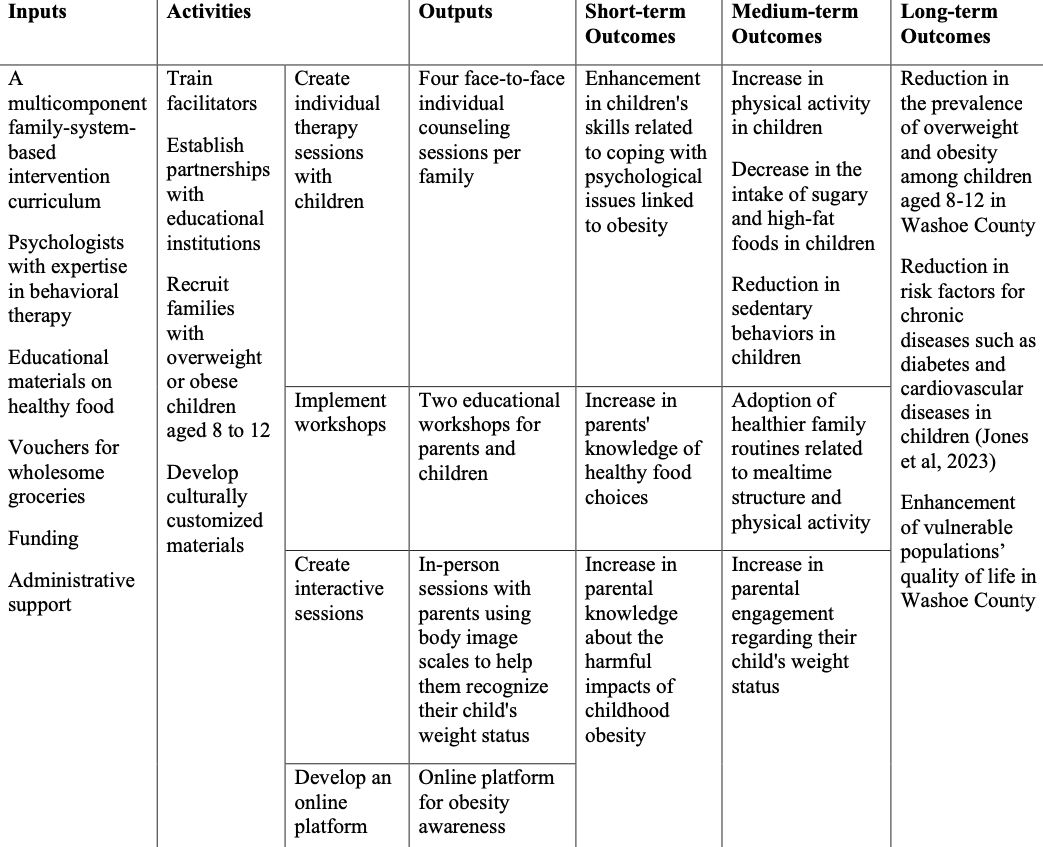
Logic Model
Table 1 – Program Logic Model
Community Stakeholders and Ensuring Cultural Sensitivity
Community Stakeholders and Their Roles
By partnering with diverse stakeholders, the program will enhance its effectiveness. The program’s instructional components can receive significant assistance from the Northern Nevada Literacy Council (NNLC). Drawing on its experience with low-income, low-literacy populations, the NNLC can help create workshops and instructional materials at the target families’ reading levels (“About Northern Nevada Literacy Council (NNLC),” n.d.). Ensuring participants understand the program’s messaging would be made possible by their advice on effective communication approaches. Furthermore, the NNLC can provide resources to hold parent education courses, offering a comfortable setting.
Urban Roots, a local group specializing in teaching via gardens, can become an important source of assistance for the interactive elements of the program (“Our story | Innovation through Outdoor Learning,” n.d.). Using their knowledge, they can deliver engaging programs for children and families that encourage hands-on learning about eating. Urban Roots might also be helpful to create a memorable curriculum for kids ages 8 to 12.
In addition, the Westbrook Community Center may offer a practical setting for in-person family education courses and individual counseling sessions. Being a well-known community area in Washoe County, it could promote participation. Various program activities might use the center’s resources, such as the conference room (“Westbrook Community Center,” n.d.).
The Westbrook Community Center might also help advertise the program in the neighborhood and stimulate family involvement. However, for the program to be successful, families with children in the impacted age range must be involved. These families will organize a focus group to offer insightful suggestions during the preparation stages. Their input will be used to modify the program’s content to better connect with the target audience. In the end, their participation would help assess the program’s perceived advantages from the users’ viewpoints.
Steps to Ensure Cultural Sensitivity
Maintaining cultural awareness is essential to the program’s acceptance within Washoe County’s diverse population. Creating a community advisory board will be prioritized from the program’s beginning. Throughout the program’s development, this advisory board will provide vital guidance to ensure that all elements—including instructional materials, interactive activities, and messaging—are culturally appropriate for the target audiences.
Additionally, the program will collaborate with community groups deeply rooted in local cultures, especially those of Hispanic descent, including the Westbrook Community Center. These collaborations will help advance knowledge of the distinctive customs that influence the health-related behaviors of the Spanish-speaking population. As a result, the program’s content may be adjusted to conform to these cultural specificities, making it more relevant (Resnicow et al., 1999).
The program will prioritize hiring culturally competent facilitators with comparable backgrounds to the target group during the implementation phase (Greene-Moton & Minkler, 2020). To engage a diverse range of community members in Washoe County and to mitigate the impact of social determinants of health on the Latino families, the program will partner with the Westbrook Community Center to provide cultural competence training for staff. The assessment process will be designed to take into account the participants’ cultural perspectives through community-based participatory focus groups (Castro et al., 2023). The program can gain insights into cultural facilitators by actively involving community members in the assessment process.
Potential Challenges and Alternative Plans
Firstly, finding skilled facilitators who are knowledgeable in motivational interviewing, cognitive-behavioral therapy (CBT), and group facilitation techniques may be challenging. It would be essential to train facilitators in these strategies, as they must thoroughly understand the concepts (McKenzie et al., 2017). Role-playing activities tailored to the intervention components—behavioral monitoring sessions, educational workshops, and family-systems group workshops—should be part of the training. Facilitators will gain the ability to handle delicate subjects. In addition, facilitators must have experience working with families and children in the 8–12 age range, the program’s target demographic.
A theoretically informed strategy that considers technical skills and contextual elements that impact the successful adoption of the intervention is necessary to develop an effective facilitator training program. This can be done by using frameworks such as the Dynamic Sustainability Framework (DSF) and the Normalization Process Theory (NPT) (Walugembe, 2019). A workable strategy would be to use NPT to guide the creation of a customized curriculum for facilitator training that addresses organizational factors and integrates the technical elements (Walugembe, 2019).
Additionally, the DSF’s techniques for organizational support might be incorporated into the facilitator training program. They include cooperative methods for designing curricula that involve facilitators as active participants. Sustainable facilitator development can also be facilitated by using online platforms, video conferencing, and collaborative tools to ensure ongoing knowledge exchange. With the aid of these virtual tools and the sharing of best practices among facilitators, the program can help build a strong learning community.
Secondly, organizing the numerous intervention components is likely to be logistically challenging, resulting in substantial administrative work. Extensive logistical preparation will be needed to coordinate the different intervention components. In particular, scheduling these elements across various venues will need to take family availability into account. It will thus be crucial to establish unambiguous communication guidelines to ensure that families and other stakeholders are consistently informed about the program’s flow.
Since some families may have trouble getting to the intervention venues, addressing transportation hurdles will also be a crucial practical consideration. Reimbursement of travel expenses could be considered to ensure fair access. To reduce attrition and meet enrollment objectives, it will be paramount to consistently reach out to and follow up with potential participants.
Effective coordination and logistics are critical to implementing the intervention successfully. The principles of DSF can also be used to build a coordinated strategy (Walugembe, 2019). This includes involving facilitators in the cooperative design of the training curriculum to foster a sense of ownership. Sustainable facilitator development can also be supported by using online platforms, video conferencing, and collaboration tools. These virtual tools and best-practice sharing can help build a strong learning community among facilitators.
Evaluation Plan
Process Evaluation Plan
A vital first step in assessing fidelity will be to create a detailed facilitator guidebook. This handbook will include scripts and guidelines to guarantee that all facilitators consistently deliver intervention components. Furthermore, each session will be videotaped, enabling an objective assessment of implementation fidelity (McKenzie et al., 2017). 20% of these video recordings will be reviewed every quarter, using a standardized fidelity checklist to assess adherence to the manual’s specified processes. Any deviations from the facilitator guidebook’s specified processes will be documented, and a process to correct them will be established. This technique allows for adequate quality assurance while reducing in-person monitoring requirements.
Reach can be measured through attendance, recorded on sign-in forms at all in-person sessions, such as counseling and workshops; these tangible records provide a tally of participation. Web analytics systems for online components will automatically capture platform usage statistics: website visits, resource downloads, and forum activity. In addition, a brief survey capturing demographic information will be completed throughout the enrollment process, allowing the program to ensure that the targeted priority group in Washoe County is adequately engaged.
Assessing response will require the use of proven, user-friendly evaluation instruments. Pre- and post-intervention assessments will use a 1–5 Likert scale to assess improvements in knowledge (e.g., “I can identify healthy portion sizes”) and self-reported behaviors (e.g., “My family ate vegetables daily this week”) (McKenzie et al., 2017). Furthermore, post-session satisfaction questionnaires, which use a 1–5 Likert scale, will assess participants’ perceptions of the relevance of the intervention components (for example, “The content was relevant to my family”) (McKenzie et al., 2017). For online components, web metrics such as time spent on the platform will be collected to offer information about participant engagement.
Outcome Evaluation Plan
The outcome assessment plan will use a quasi-experimental methodology to evaluate the program’s outcome targets and short- to medium-term results. The difficulties of randomly allocating participants to intervention and control groups in a community-based program necessitate a quasi-experimental method (McKenzie et al., 2017). In the short term, parental knowledge will be assessed.
Using a pretest-posttest design, a validated questionnaire on topics such as balanced diets, portion management, recommended physical activity levels, and understanding BMI will be administered before and after the intervention. Validated measures will assess changes in parental knowledge, family behaviors, and weight perceptions. The control group for comparison will be drawn from communities that have not yet received the intervention. This technique will allow for a direct comparison of participants’ knowledge levels before and after they receive the program’s instructional components.
The medium-term outcomes will be assessed using two major metrics. To begin, changes in family eating and exercise habits will be measured using self-reported data obtained through online questionnaires. Parents will be asked to report on the good habits practiced in their homes, such as increased fruit and vegetable eating, reduced sugar intake, and increased physical activity. This data will be collected at baseline and at two months following the intervention, enabling the program to monitor behavioral changes over time.
Secondly, parental perceptions of their child’s weight status will be assessed using the Body Image Scale (BIS), a visual tool designed to help parents accurately determine their child’s BMI category. Participants will complete the BIS assessment at baseline and throughout the follow-up phase. This will allow the program to identify whether the intervention successfully altered parental views of their child’s weight status.
The primary analysis will compare the intervention group’s pre- and post-knowledge questionnaire scores, reported behavioral improvements, and BIS assessments. To account for secular trends and historical impacts, a non-equivalent control group will be drawn from families on a waiting list or from comparable communities, where the intervention has not yet been implemented (McKenzie et al., 2017). This technique will serve as a reference point for understanding the program’s impact and any external factors that may influence outcomes.
Furthermore, process data gathered during implementation, such as attendance records, participant satisfaction questionnaires, and fidelity evaluations, will be examined as potential modifiers of the results. Subgroup analyses by demographic factors may reveal differences in the intervention’s effectiveness across subpopulations within the Washoe County community. The mixed-methods approach, which combines quantitative surveys and the validated BIS tool, will provide insight into the program’s efficacy in meeting its objectives.
Dissemination of Findings
A report will be prepared and sent digitally to funding agencies, partner groups, and the Washoe County Health District. The evaluation will use a utilization-focused approach to ensure that the findings are relevant to stakeholders. A taped presentation summarizing the results will be made available for easy access by families and residents. Finally, the county health department will be asked to report the findings at its monthly public meetings, providing evidence to support ongoing funding for local childhood obesity prevention programs. This multi-pronged approach increases digital distribution and allows for meaningful contact with key stakeholders.
Program Budget
Budget Narrative
- A $100,000 total grant from the Mississippi State Department of Health.
- Credentialed psychologists who provide in-person therapy sessions will be paid $50 per hour for an estimated 80 hours of counseling.
- Three facilitators will hold instructional sessions on physical activity and nutrition with an hourly pay of $30.
- Four committed community health professionals will lead in-person sessions for 20 hours a week with a $25 hourly salary.
- A team of online platform developers will develop the MapMe adaptation’s website and online resources. The team will put in approximately 400 hours during the development phase. The average hourly salary for developers will be $50.
- Two administrators will be selected to oversee the daily operations of the online platform: these responsibilities will take up 10 hours a week for each administrator, paid $35 per hour.
- The team will feature a cybersecurity specialist; they will be paid $65 per hour.
- The production and printing of the educational materials will cost $1,450.
- $3,000 cover the rental of a router, speakers, microphones, a projector, and screens.
- $3,000 has been allocated to gift cards for healthy groceries.
- $4,500 has been set aside for translating intervention materials into Spanish.
- $1,200 has been set aside for domain registration and web hosting.
- $7,200 has been allocated for the rental of community center space. The rental cost is $40 per hour; 180 hours in total are scheduled for both phases of the intervention (“Westbrook Community Center, n.d.).
- A $550.00 refundable cleaning and security deposit will be needed (“Westbrook Community Center, n.d.”).
- $1,500 will be used to distribute promotional materials to raise awareness of the program.
- $1,500 will be allocated for the workers to attend an online course on evidence-based behavioral health interventions.
- A contingency fund (5% of total expenditures) accounts for potential emergencies and adjustments.
References
About Northern Nevada Literacy Council (NNLC). (n.d.). Northern Nevada Literacy Council (NNLC).
Brown, C. L., Halvorson, E. E., Cohen, G. M., Lazorick, S., & Skelton, J. A. (2015). Addressing childhood obesity. Pediatric Clinics of North America, 62(5), 1241–1261.
Castro, F. G., Berkel, C., & Epstein, D. R. (2023). Cultural adaptations and cultural factors in EBI implementation with Latinx communities. Frontiers in Public Health, 11.
Centers for Disease Control and Prevention. (2022). Childhood obesity facts | Overweight & obesity | CDC (Fact sheet).
García-Blanco, L., Berasaluce, A., Romanos-Nanclares, A., Martínez‐González, M. Á., Moreno‐Galarraga, L., & Martín‐Calvo, N. (2022). Parental perception of child’s weight, their attitudes towards child’s dietary habits and the risk of obesity. World Journal of Pediatrics, 18(7), 482–489.
Greene-Moton, E., & Minkler, M. (2020). Cultural competence or cultural humility? Moving beyond the debate. Health Promotion Practice, 21(1), 142-145.
Harroud, A., Mitchell, R., Richardson, T. G., Morris, J., Forgetta, V., Smith, G. D., Baranzini, S. E., & Richards, J. B. (2021). Childhood obesity and multiple sclerosis: A Mendelian randomization study. Multiple Sclerosis Journal, 27(14), 2150–2158.
Hughto, J. M. W., Reisner, S. L., & Pachankis, J. E. (2015). Transgender stigma and health: A critical review of stigma determinants, mechanisms, and interventions. Social Science & Medicine, 147, 222–231.
Jones, A. R., Mann, K., Cutler, L., Pearce, M. S., Tovée, M. J., Ells, L., Araújo‐Soares, V., Arnott, B., Harris, J. M., & Adamson, A. J. (2023). A randomised control trial investigating the efficacy of the MAPME intervention on parental ability to correctly categorise overweight in their child and the impact on child BMI Z-Score change at 1 year. Children (Basel), 10(9).
Li, Z., Samara, A., Ray, M. K., Rutlin, J., Raji, C. A., Shimony, J. S., Sun, P., Song, S., Hershey, T., & Eisenstein, S. A. (2023). Childhood obesity is linked to putative neuroinflammation in brain white matter, hypothalamus, and striatum. Cerebral Cortex Communications, 4(2).
Lombardo, J., Whitley, R., Sherych, L., & Azzam, I. (2022). Nevada annual obesity report – December 2022 [PDF document]. Nevada Department of Health and Human Services.
McKenzie, J. F., Neiger, B. L., & Thackeray, R. (2017). Planning, implementing, & evaluating health promotion programs: A primer (7th ed.). Pearson Education.
National Cancer Institute. (2005). Theory at a glance: A guide for health promotion practice (2nd ed.). U.S. Department of Health and Human Services, National Institutes of Health.
Our story | Innovation through Outdoor Learning. (n.d.). Urban Roots.
Peoples-Sheps, M. D. (2001). Development and selection of interventions. University of North Carolina at Chapel Hill.
Resnicow, K., Baranowski, T., Ahluwalia, J. S., & Braithwaite, R. L. (1999). Cultural sensitivity in public health: Defined and demystified. Ethnicity & Disease, 9(1), 10–21.
Rojo, M., Lacruz, T., Solano, S., Vivar, M., Del Río, A., Martínez, J., Foguet, S., Marín, M. M., Moreno-Encinas, A., Veiga, Ó. L., Cabanas, V., Rey, C., Graell, M., & Sepúlveda, A. R. (2022). ENTREN-F family-system based intervention for managing childhood obesity: Study protocol for a randomized controlled trial at primary care. Obesity Research & Clinical Practice, 16(4), 319–329.
Romanelli, R. M., Cecchi, N., Carbone, M. G., Dinardo, M., Gaudino, G., Del Giudice, E. M., & Umano, G. R. (2020). Pediatric obesity: Prevention is better than care. Italian Journal of Pediatrics, 46(1).
Sahoo, K., Sahoo, B., Choudhury, A., Sofi, N. Y., Kumar, R., & Bhadoria, A. S. (2015). Childhood obesity: Causes and consequences. Journal of Family Medicine and Primary Care, 4(2), 187.
Smith, E. A., & Caldwell, L. L. (2007). Adapting evidence‐based programs to new contexts: What needs to be changed? Journal of Rural Health, 23(s1), 37–41.
Student weight status in Washoe County School District, 2018-2019. (2019). Washoe County Health District, 39(16), 1–2.
Walugembe, D. R., Sibbald, S. L., Ber, M. J. L., & Kothari, A. (2019). Sustainability of public health interventions: Where are the gaps? Health Research Policy and Systems, 17(1).
Westbrook Community Center. (n.d.). Washoe County.