Introduction
In 2007, Apple introduced the iPhone, which revolutionized the mobile phone industry through its innovative approach, full touchscreen, internet connectivity, and music capabilities. The idea followed the principles of innovation diffusion, which examines how concepts in the business world develop over time (Wanzenböck & Frenken, 2020).
This paper will examine the diffusion of the iPhone and its impact on the mobile phone landscape. The study will ultimately shed light on innovation management processes and reveal the complex relationship among technology, consumer behavior, and the market. Thus, it can be concluded that, while the iPhone is an incremental product innovation, it has transformed the industry and generated significant revenue for Apple.
iPhone as a Product Innovation
The iPhone is considered a great product innovation due to several features that set it apart from its competitors. As Steve Jobs stated during its 2007 launch, the iPhone was a revolutionary product with different integrated features (Kim et al., 2021; Vidanec, 2020). Before the launch, smartphones were available in the industry, but many combined touchscreen capabilities with a physical keyboard and had limited functionality (Mkpojiogu, Akusu, Hussain, Kamal, & Lim, 2020).
However, the groundbreaking design of this new phone diverged from these traditional strategies, incorporating a sleek touchscreen interface, a minimalist design, and unprecedented integration of the product’s hardware and software. The multi-touch design allows users to seamlessly interact with the device through tapping, pinching, and swiping (Ellavarason, Guest, Deravi, Sanchez-Riello, & Corsetti, 2020). The iPhone’s utility and appeal were further enhanced by its launch alongside the App Store, which enabled developers to design and distribute iOS applications. Today, it remains a great product innovation thanks to Apple’s ongoing commitment to continually improving the product and releasing new models regularly.
The iPhone as an Incremental Innovation
Several reasons make the iPhone an incremental innovation, despite some of its impacts being disruptive. Incremental product innovation entails improving and adapting an existing service or product. Smartphones existed before the iPhone launched, but their designs were poor (Shetty & Bhat, 2022).
Indeed, the iPhone was not the first mobile phone to incorporate features such as touchscreen technologies, internet connectivity, or music. The innovators merged and integrated these features into a single product and ensured that its operating system could handle the new functionalities (Hadi, 2021). The integration was thus an incremental innovation that combined existing technologies and added storage and RAM to the devices, enabling them to operate without breaking down.
To date, one of the iPhone’s best features is its user interface (UI). This interface is often complimented for its simplicity, flexibility, interactivity, and efficiency (Bunian et al., 2021). The iPhone home screen was the first to allow users to customize its design and feel (Qi & Xue, 2020; Yi, Wang, Tian, & Xia, 2021). The phone also led the way in designing better multi-touch gestures, allowing users to use multiple fingers simultaneously (Gorlewicz et al., 2020). Thus, the continuous improvement of the phone’s multi-touch gestures over the years can be considered an incremental innovation rather than a radical one.
Theoretical Frameworks
Diffusion
Diffusion Definition
In the context of innovation, diffusion refers to the process by which innovations and ideas spread through society over time. The theory seeks to explain why, how, and at what rate the system can adopt new ideas, products, or services (Al-Rahmi et al., 2021; Turin, Kazi, Rumana, Lasker, & Chowdhury, 2023; Yuen, Cai, Qi, & Wang, 2021). The process typically follows a series of steps that entail creating awareness, generating interest, evaluating, testing, and adopting (Lindgren, 2020).
The process can be influenced by several factors, including the innovation’s advantages, existing solutions, and complexity. The channel used to communicate the innovation also influences the rate and degree of acceptance of new technology or innovation (Dayyala, Zaidi, & Bagchi, 2020). Innovators must understand diffusion since it can help them tailor their inventions to be more acceptable to the target market.
Stages of iPhone’s Adaptation
The diffusion of the iPhone followed both the S-curve and Rogers’ bell curve, two models that explain how consumers receive innovations. According to the bell curve, inventions can be categorized into five groups: innovators, early adopters, early majority, late majority, and laggards (Dale, McEwan, & Bohan, 2021; Palm, 2020; Ruokamo, Laukkanen, Karhinen, Kopsakangas-Savolainen, & Svento, 2023). The innovators are the first group to receive an idea, usually about 2.5% of the population (Mo et al., 2021). This group is generally venturesome and risk-taking, willing to take in a new idea even when they are sure it is likely to fail.
After innovators come the early adopters, who are the first people to interact with a technological invention. Early adopters of the iPhone emerged in 2008, when the device began to appeal to a wide range of audiences not involved in its design and testing (Fang, Wu, & Clough, 2021). This group comprises tech enthusiasts and early-stage adopters who are willing to try new devices and software (Tjora, Løvik, Hansen, & Skaar, 2021). The group was amazed by the product and played a crucial role in recommending it to their family and peers (Ho, 2022). Other early adopters of the iPhone included professionals in fields such as finance and media, fashion-conscious people drawn to the phone’s sleek design, and early social media users.
The early innovators precede the early majority, who are the first people in society to access a device programmatically before its launch. One of their key characteristics is their value orientation, which involves seeking clear, tangible benefits from a product or service (Petrović, 2023). In the case of the iPhone, the early majority sought to enjoy the improved communication outlet the phone would provide.
The iPhone’s marketing strategy likely influenced them as a phone, an internet communicator, and a music player (Wang, 2023). Their interactions with innovators also influenced the group and early adopters, who observed the phone’s touchscreen capabilities and its efficient iOS system. Price sensitivity was also key to attracting the early majority to use the iPhone (Jamalova & Constantinovits, 2020). The comfort of the previous adopters also influenced the group, as they had seen them use the technology and become satisfied with the results.
The late majority began purchasing the iPhone in the years following the launch of the iPhone 6, which was a breakthrough product. The product was able to shake the caution and skepticism that is associated with this group of consumers. The group is also characterized by being risk-averse and thus adept at adopting new technologies (Lund et al., 2020). Therefore, they waited several years until 2014, when the phone delivered clear benefits and value to its users.
The laggards are usually the last group to accept and try a new technology. The group is highly resistant to change and demonstrates little knowledge of the latest technologies (Evans & Britt, 2023). Laggards in the iPhone’s market diffusion are older people or individuals accustomed to other mobile technologies, such as Android. These people are just slowly getting used to iPhone and smartphone technologies as the world is increasingly digitalizing, making technology critical for every individual in society. The fact that laggards are now getting used to the iPhone in the US indicates near-market saturation, and the product’s growth could plateau.
Nature of iPhone Innovation
The nature of iPhones fits the heterogeneous innovation model rather than the epidemic/learning model for several reasons. Heterogeneous innovations are periodic, as diverse populations and individuals adopt technology at different rates (Staccioli & Virgillito, 2021). The nature and degree of adaptation to these innovations also vary depending on individuals’ choices and preferences. Among iPhone early adopters, comprised mostly of tech enthusiasts, the technology and its cutting-edge features were embraced immediately after the release (Dempsey, 2021).
As the technology was tried and tested, the early majority felt they could join the group of users. The late majority, who are naturally risk-averse, waited until constant feedback and reviews about the phone were available, while the laggards are still less hesitant to use the iPhone. These different segments of the technology adoption show that it was a heterogeneous type of innovation.
The S-curve of Diffusion
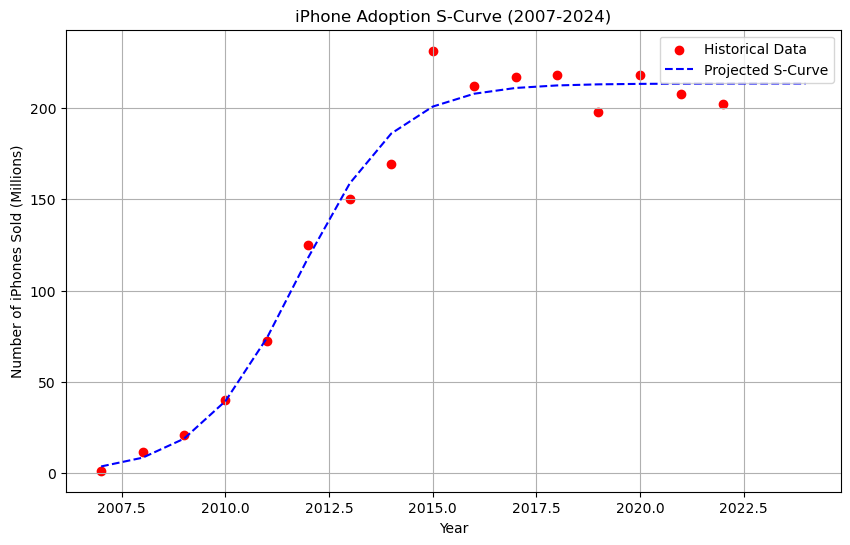
The S-curve is a graphical representation of how people are likely to adopt a particular innovation. The first stage of the S-curve is slow initial growth, where the customers are getting used to a new product or service (Priestley, Sluckin, & Tiropanis, 2020). Regarding the bell curve, this stage represents a period when the product is known only to innovators and early adopters. The early and late majority, as represented by the bell curve, are concerned.
The final stage of the S-curve is the maturity and saturation stage. In this stage, innovation stops growing, and only a few laggards are occasionally convinced of it. iPhone is at the maturity and saturation stage since most potential clients have already tried the product, as shown in Figure 1 (see appendix).
Relationship between the S-curve and the Bell Curve
iPhone S-curve is closely related to its bell as the stages in the two theories match. Innovators and early adopters represent a minority segment of the population; thus, growth is more likely to be slow when this demographic adopts a technology. In contrast, the early and late majority groups represented the largest segment of the population; thus, they were responsible for the rapid growth of new adopters observed in the years following 2010 (Biswas et al., 2022).
The growth is likely to be fast until most of these two groups have access to smartphones. This would lead to the maturity and saturation stage, which the iPhone is expected to be. Laggards, like innovators and early adopters, are in the minority and are likely to result in slow adoption growth. Thus, though different, the S and the bell curve are closely related.
Conclusions on the Diffusion Rate of iPhone
The iPhone’s diffusion rate since its launch, according to data, shows it is a great innovation. The slow growth at first signified that users had not yet discovered the product, or that the organization’s marketing campaigns had not yet reached a wider audience. However, over time, the curve began to rise, indicating that innovators and early adopters had liked what the innovation offered and were therefore recommending it to their peers. This aspect led to a surge in adoption, as many people, including the early and late majority, began purchasing the phone due to its sleek design, interactive user interface, and integrated features (Niessen, 2021). The stalled growth of the iPhone today reveals that the company has already reached most of its potential clients, and only a few laggards are joining.
Dominant Design
How the iPhone became the Standard Design
Today, the iPhone is considered the dominant design and standard in the smartphone industry for several reasons. The phone achieved this status by introducing revolutionary design and features. When the first iPhone was launched in 2007, phones were not associated with sleek design, intuitive touchscreens, or several multi-touchscreen gestures (Zhou, 2020). The phone was a first mover in this design, and many of its competitors are imitating its strategies.
Secondly, the dominance was facilitated by the integrated ecosystem that is associated with the iPhone. This diverse ecosystem includes iOS, the App Store, iCloud services, and significant interconnectivity with other devices, such as the MacBook and iPad. The iPhone follows an iterative management strategy in which each new feature added to the phone improves the device’s usability (Wang et al., 2021). For instance, the iPhone undergoes rigorous annual improvements that keep it at the forefront of technological innovation.
The iPhone as a First Mover
The iPhone can be considered a winner in the industry standard, as a first mover and a fast follower, depending on the type of feature being discussed. Regarding the touchscreen interface, it was a fast follower of the dominant smartphones at the time, such as the BlackBerry, which usually integrated touchscreen capabilities with a physical keyboard (Park, 2022; Perdigones, Ruiz-Mazarrón, Cañas, & García, 2021). The iPhone was thus a fast follower by ensuring that its smartphones would be fully screen-based, an aspect that gave the phone a great competitive advantage. The iPhone was also a fast follower of smartphone operating system developments.
Strategies Adopted by Apple to Win the Standards Race
Apple, the parent company of the iPhone, adopted several strategies to win the standards race. Apple focused on creating differentiation and innovation to ensure the iPhone stood out from existing mobile phones (Baron, 2020). The phones had an ecosystem lock-in; thus, once members purchased an iPhone, it was difficult for them to cross to other manufacturers.
Apple used a vertical integration strategy, manufacturing the hardware and software for the phone (Geradin & Katsifis, 2021). The Branding and marketing strategy Apple employed positioned its products as premium offerings, enabling it to achieve greater profitability than its competitors. Finally, Apple invested in creating developer support and partnerships, allowing its ecosystem to grow.
Network Effects
Several network effects and externalities are associated with the iPhone. One example of a network effect valuable to iPhone consumers is the company’s app ecosystem, which enables phone users to continue accessing diverse products (Tavalaei & Cennamo, 2021). This aspect, in turn, results in the iPhone having many applications for communication, productivity, gaming, and other types of entertainment. iPhones, iMessage, and FaceTime leverage network effects and are only available to users of those devices, thus encouraging them to stay in the ecosystem.
Software and hardware integrations achieve lock-in, keeping users on Apple’s products. The consequences of this lock-in range from increased customer loyalty to revenue growth and the iPhone gaining a competitive advantage. Apple has increased the network through Ecosystem integration, offering exclusive features, the curated approach of the App Store, and developer partnerships.
Innovation and Business Performance
The iPhone generates the most revenue for Apple. Data from Investopedia (2022) shows that of Apple’s $260 billion in revenue in 2019, $142.3 billion came from the iPhone, accounting for around 55% of total revenue. Moreover, these revenues are associated with significant profitability, as the iPhone is priced as a premium product (Hawari & Rustiadi, 2022). The profits from phone sales are reinvested in phone manufacturing or in other activities, such as R&D or philanthropic work, to strengthen Apple’s brand. The strengths of the data used are that it is quantifiable and drawn from reliable sources such as organizational financial statements and sustainability reports.
The research concludes that the iPhone was Apple’s best innovation. However, this observation could be limited by scope constraints, external factors that may affect the trend, and lagging indicators that reflect past performance rather than future potential. Other performance indicators also show that the iPhone’s impact on its parent company has been substantial. For instance, the iPhone’s revenue growth over the last five years has been faster than that of the organization’s other products (Dave & Balu, 2022). The iPhone’s market share in the smartphone industry is also higher than Apple’s share in the laptop industry.
Evaluation of the iPhone
Based on the analysis conducted, it can be concluded that the iPhone has been a remarkably successful product innovation. The revolutionary design features a multidimensional user interface, an integrated touchscreen, and a sleek design, ensuring high client acceptance and low client attrition (Verma & Sambhav, 2020). The marketing strategy, primarily through product differentiation, has ensured that few iPhone clients can switch to competing mobile phone producers. The ecosystem lock-in and the robust security features analyzed in the previous section have also been critical in maintaining the client’s loyalty and satisfaction.
Short-term Trajectory of the iPhone
The iPhone is expected to maintain its market dominance and positive trajectory over the short term. The organization has maintained a culture of releasing new and better iPhone models each year. The improvements have ensured that clients who have already acquired continue to purchase new iPhone products to keep up with the latest trends and innovations. Moreover, despite market saturation in the US and most developed nations, opportunities remain to continue expanding into the developing world (George, 2023). Moreover, the iPhone will likely alter its manufacturing strategies to align with sustainability goals.
Conclusion
The iPhone is a quintessential example of how incremental technologies can permeate the market, gain dominance, and become a standard and role model for competitors. Introduced in 2007, the iPhone integrated features across both hardware and software, resulting in excellent product differentiation. As a consequence, this product innovation has grown from a slow rate to near market saturation. However, by consistently innovating and frequently launching new smartphone models, the iPhone contributed more than half of its parent company’s total revenue. In the near term, this product is expected to remain profitable despite a plateau.
References
Al-Rahmi, W. M., Yahaya, N., Alamri, M. M., Alyoussef, I. Y., Al-Rahmi, A. M., & Kamin, Y. B. (2021). Integrating innovation diffusion theory with technology acceptance model: Supporting students’ attitude towards using a massive open online courses (MOOCs) systems. Interactive Learning Environments, 29(8), 1380-1392.
Baron, D. P. (2020). Vertical differentiation, product innovation, and dynamic competition. Journal of Economics & Management Strategy, 29(3), 635–662.
Biswas, S., Ali, I., Chakrabortty, R. K., Turan, H. H., Elsawah, S., & Ryan, M. J. (2022). Dynamic modeling for product family evolution combined with artificial neural network based forecasting model: A study of iPhone evolution. Technological Forecasting and Social Change, p. 178.
Bunian, S., Li, K., Jemmali, C., Harteveld, C., Fu, Y., & Seif El-Nasr, M. S. (Eds.). (2021). In Proceedings of the 2021 CHI Conference on Human Factors in Computing Systems. ACM Digital Library.
Dale, V., McEwan, M., & Bohan, J. (2021). Early adopters versus the majority: Characteristics and implications for academic development and institutional change. Journal of Perspectives in Applied Academic Practice, 9(2), 54-67.
Dave, P. & Balu, N. (2022). Apple forecasts faster sales growth, strong iPhone demand despite glum economy. Reuters.
Dayyala, N., Zaidi, S. K. R., & Bagchi, K. (2020). Diffusion of IFRS using innovation diffusion models. International Journal of Accounting & Information Management, 28(4), 685–701.
Dempsey, L. (2020). Technological acceptance and media literacy 2005-2018: A longitudinal study of outlooks before, during and post internet adoption. The Journal of Media Innovations, 6(1), 77-92.
Ellavarason, E., Guest, R., Deravi, F., Sanchez-Riello, R., & Corsetti, B. (2020). Touch-dynamics based behavioral biometrics on mobile devices–a review from a usability and performance perspective. ACM Computing Surveys (CSUR), 53(6), 1-36.
Evans, M. I., & Britt, D. W. (2023). Resistance to change. Reproductive Sciences, 30(3), 835-853.
Fang, T. P., Wu, A., & Clough, D. R. (2021). Platform diffusion at temporary gatherings: Social coordination and ecosystem emergence. Strategic Management Journal, 42(2), 233–272.
George, A. S. (2023). Evaluating India’s economic growth: Challenges and opportunities on the path to 5 trillion dollars. Partners Universal International Innovation Journal, 1(6), 85–109.
Geradin, D., & Katsifis, D. (2021). The antitrust case against the Apple app store. Journal of Competition Law & Economics, 17(3), 503-585.
Gorlewicz, J. L., Tennison, J. L., Uesbeck, P. M., Richard, M. E., Palani, H. P., Stefik, A., Smith D. W., & Giudice, N. A. (2020). Design guidelines and recommendations for multimodal, touchscreen-based graphics. ACM Transactions on Accessible Computing (TACCESS), 13(3), 1-30.
Hadi, A. S. (2021). The influence of product attribute, promotion mix, distribution channel, and price toward repurchase intention on iPhone. Asian Management and Business Review, 95–104.
Hawari, M. T., & Rustiadi, S. (2022). Premium on a budget: Second-hand iPhones in Indonesia. International Journal of Current Science Research and Review. ISSN, 2581-8341.
Ho, J. C. (2022). Disruptive innovation from the perspective of innovation diffusion theory. Technology Analysis & Strategic Management, 34(4), 363–376.
Investopedia (2022). The economics of the iPhone.
Jamalova, M., & Constantinovits, M. G. (2020). Attitudes toward smartphone characteristics: What do users pay for?. International Journal of Interactive Mobile Technologies, 14(9).
Kim, J., Jeong, B., Kim, D., Kim, J., Jeong, B., & Kim, D. (2021). Who drives innovation? Apple. Patent Analytics: Transforming IP Strategy into Intelligence, 139-148.
Lindgren, S. A. (2020). Clean cooking for all? A critical review of behavior, stakeholder engagement, and adoption for the global diffusion of improved cookstoves. Energy Research & Social Science, 68, 1-15.
Mkpojiogu, E. O., Akusu, G. E., Hussain, A., Kamal, F. M., & Lim, C. K. (2020). Comparing the quality-of-service performance of iPhone X and Samsung S9 plus smartphones with WhatsApp messenger. International Journal of Advanced Science and Technology (IJAST), 29(08), 194-200.
Mo, P. K. H., Luo, S., Wang, S., Zhao, J., Zhang, G., Li, L., & Lau, J. T. (2021). Intention to receive the COVID-19 vaccination in China: Application of the diffusion of innovations theory and the moderating role of openness to experience. Vaccines, 9(2), 129.
Niessen, N. (2021). Shot on iPhone: Apple’s world picture. Advertising & Society Quarterly, 22(2), 1–18.
Palm, A. (2020). Early adopters and their motives: Differences between earlier and later adopters of residential solar photovoltaics. Renewable and Sustainable Energy Reviews, 133, 1–14.
Park, C. (2022). Different determinants affecting first and late mover advantage in a smartphone market: A comparative analysis of Apple iPhone and Samsung Galaxy. Technology Analysis & Strategic Management, 34(3), 274–289.
Perdigones, A., Ruiz-Mazarrón, F., Cañas, I., & García, J. L. (2021). Apps as a learning vehicle in urban naturing and sports fields. South Florida Journal of Development, 2(1), 432-439.
Petrović, E. K. (2023). Sustainability transition framework: an integrated conceptualization of sustainability change. Sustainability, 16(1), 217.
Priestley, M., Sluckin, T. J., & Tiropanis, T. (2020). Innovation on the web: The end of the S-curve?. Internet Histories, 4(4), 390–412.
Qi, W., & Xue, J. (2020). Visual design of smartphone app interface based on user experience. Computer Aided Design and Applications, 17, 89-99.
Ruokamo, E., Laukkanen, M., Karhinen, S., Kopsakangas-Savolainen, M., & Svento, R. (2023). Innovators, followers and laggards in home solar PV: Factors driving diffusion in Finland. Energy Research & Social Science, 102, 1-13.
Shetty, K. A., & Bhat, S. (2022). Advancement and contribution of mobile smartphones to the consumer. International Journal of Case Studies in Business, IT and Education (IJCSBE), 6(2), 699-713.
Staccioli, J., & Virgillito, M. E. (2021). Back to the past: The historical roots of labor-saving automation. Eurasian Business Review, 11, 27-57.
Statista (2023). Unit sales of the Apple iPhone worldwide from 2007 to 2022.
Tavalaei, M. M., & Cennamo, C. (2021). In search of complementarities within and across platform ecosystems: Complementors’ relative standing and performance in mobile apps ecosystems. Long Range Planning, 54(5), 1-19.
Tjora, A., Løvik, L. E. L., Hansen, F. H., & Skaar, M. (2021). Shameful technological impertinence: Consumer ambivalence among iPad early-buyers. Societies, 11(3), 73.
Turin, T. C., Kazi, M., Rumana, N., Lasker, M. A. A., & Chowdhury, N. (2023). Employing diffusion of innovation theory for ‘not missing the mass’ in community-engaged research. BMJ Open, 13(8), 1-7.
Verma, N., & Sambhav, S. (2020). Development of iOS: A revolutionary transformation and the future. International Journal of Advanced Research in Engineering and Technology, 11(6), 445–454.
Vidanec, D. (2020). Philosophizing the Jobs’s iPhone within philosophical hermeneutics context. Athens Journal of Humanities & Arts, 7(3), 185–208.
Wang, N., Chen, S., Xiao, L., & Fu, F. (2021). The sustainability of superior performance of platform complementor: Evidence from the effects of iterative innovation and visibility of app in iOS platform in China. Sustainability, 13(7), 4034.
Wang, R. (2023). Analysis of Apple’s classic Ads-strengths and weaknesses. Highlights in Business, Economics and Management, pp. 19, 752–759.
Wanzenböck, I., & Frenken, K. (2020). The subsidiarity principle in innovation policy for societal challenges. Global Transitions, 2, 51-59.
Yi, M., Wang, Y., Tian, X., & Xia, H. (2021). User experience of the mobile terminal customization system: The influence of interface design and educational background on personalized customization. Sensors, 21(7).
Yuen, K. F., Cai, L., Qi, G., & Wang, X. (2021). Factors influencing autonomous vehicle adoption: An application of the technology acceptance model and innovation diffusion theory. Technology Analysis & Strategic Management, 33(5), 505-519.
Zhou, W. (2020). Mobile assisted Chinese learning as a foreign language: An overview of publications between 2007 and 2019. Frontiers of Education in China, 15, 164-181.
Appendix