Introduction
The world of art history has no period that compares to the epoch that shaped and transformed Paris’s creative output in the 19th century. In the rush of the French capital’s busy streets and smoky cafes, artists struggled with the stormy currents of industrialization, urbanization, and the transformation of social relationships and values. Against this background, Édouard Manet’s Olympia (1863) can be described as an unprecedented authority that represents the latest movement within the artistic establishment and redefines artistic expression.
The essay is written temporally; therefore, it starts this historical journey by examining the socio-cultural flows in the shocking painting. Comparing Olympia with Edgar Degas’s The Absinthe Drinker and Pierre-Auguste Renoir’s Luncheon of the Boating Party reveals common themes, divergent ideas, and the eternal appeal of 19th-century Paris. Comparing the two iconic works of art from different cultures, we encounter artistic inventions and deep insights into the human being in motion. Depicting everyday scenes from the life of Parisians, all three paintings remind us of the timeless power of art to reflect, critique, and transcend the tumult of its time.
Analysis of the Artworks
Olympia
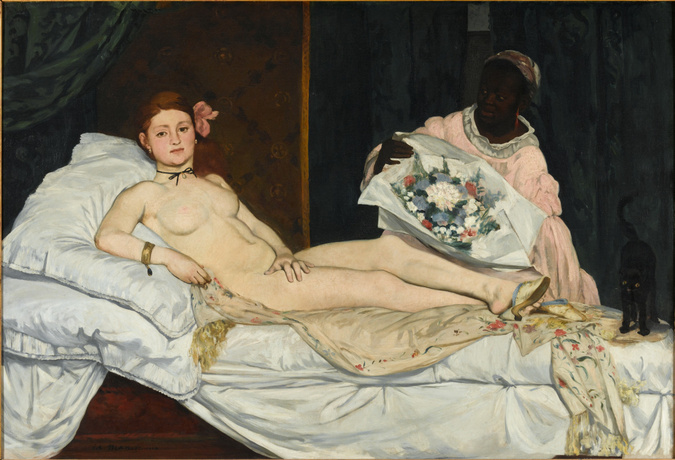
Manet’s Olympia (1863) is a crucial work marked by an echoing uprising and transformative means. The rebellion against the established conventions of its time is both aesthetic and moral. At first glance, Olympia presents a scene of unabashed sensuality, depicting an inclined nude woman like Venus, which evokes her historical representations (McCauley, 2020). However, Olympia relied on modern life and did not bend to the idealized goddess, shedding the calm veneer of mythology while exposing her with sharp, braless energy (McCauley, 2020). She intentionally sends the message that she is a real-life woman, not an allegorical figure, as seen in her breaking the traditional narrative of beauty and virtue, prompting viewers to rethink their true intentions and reevaluate the power hierarchy.
At the composition’s core is Olympia’s unwavering stare, captured so that it seems to come through the canvas and directly to the viewer, leaving us both confused and enthralled. The model’s confrontational and defiant gaze contrasts sharply with the lean look of the passivity imposed by male subjects (McCauley, 2020). Instead, the model declares her uniqueness, impenetrable to suppression and objectification, by advocating for her autonomy. This assertiveness is further emphasized by a black servant holding a bouquet in the practice of serving as a servant in the accepted practice of the previous centuries, colonialization) relations in this work.
Manet’s extraordinary skill in color and composition adds another layer of meaning, highlighting symbolic resonance. The intensification of contrast between the radiant complexion of Olympia and the dark background leads to the emergence of her presence, not forgetting the clever placement of objects, such as the golden bracelet and a shawl, right beside her nude body, for they also construct this image of an expensive commodity (McCauley, 2020). Such a simultaneous presence of wealth and frailty garners artists an opportunity to critique for positing the female body as a commodity, and, eventually, the transitory nature of people’s desires and intimate relationships in the patriarchal society is exposed.
Given its emergence against the backdrop of massive social and artistic transformation, Olympia also becomes an excellent expression of a sense of time and place. The advent of industries and urbanization was accompanied by radical changes in urban life, which strained the existing modes of contemplation and interaction (McCauley, 2020). When Manet refused to conform to academic art standards and adopted a realist approach, it became a big deal because it was a formal statement of departure from the custom and set the stage for future art movements, like Impressionism.
The Absinthe Drinker
The painting of Manet has something in common with Degas’s The Absinthe Drinker, in which the woman is depicted sitting hunched over a table in solitude as she contemplates. Both paintings depict the leftovers and melancholy of fin-de-siècle Paris, mainly due to rapid industrialization and socio-urbanization. Nevertheless, The Absinthe Drinker is an example of the intoxicating force of absinthe and the isolation of women’s lives in cities (Degas, 1876). Both paintings adopt a gloomy style, focusing on the dark city and its mysterious life.
Luncheon of the Boating Party
On the contrary, Renoir’s Luncheon of the Boating Party is full of zest and lots of fun; it is clearly about the joys of companionship and leisure against the backdrop of terraces bathing in Parisian sunshine. Done in front of the Seine, the composition exhibits a range of characters in an active conversation (Renoir, 1880). The lively brushwork and warm color scheme suggest the happy-go-lucky attitude that characterized the end of the nineteenth century (McCauley, 2020). However, beneath the veneer, the painting reveals social inequity and the dynamics of gender. The fact that workers in the ranks of bourgeois bohemians come from the working class challenges social class barriers and sheds light on the subversive flavor of modernity.
Conclusion
The artworks, taken together, portray the diverse colors of 19th-century Parisian Society. They reveal how intricate the nature of living could be at the brink of modernity (McCauley, 2020). Whether Manet’s provocative gaze, Degas’s meditative realism, or Renoir’s unbridled zest, each painting pictures one facet of human nature, drawing the viewers into reflection on who we are, where we are heading, and how we fit on this planet.
References
Degas, E. (1876). The Absinthe Drinker (painting). Musée d’Orsay, Paris, France.
Manet, E. (1863). Olympia (painting). Musée d’Orsay, Paris, France.
McCauley, A. (2020). Beauty or beast? Manet’s Olympia in the age of comparative anatomy. Art History, 43(4), 742-773.
Renoir, P.-A. (1880). Luncheon of the Boating Party (painting). The Phillips Collection, Washington, DC, United States.
Appendix A