
Introduction
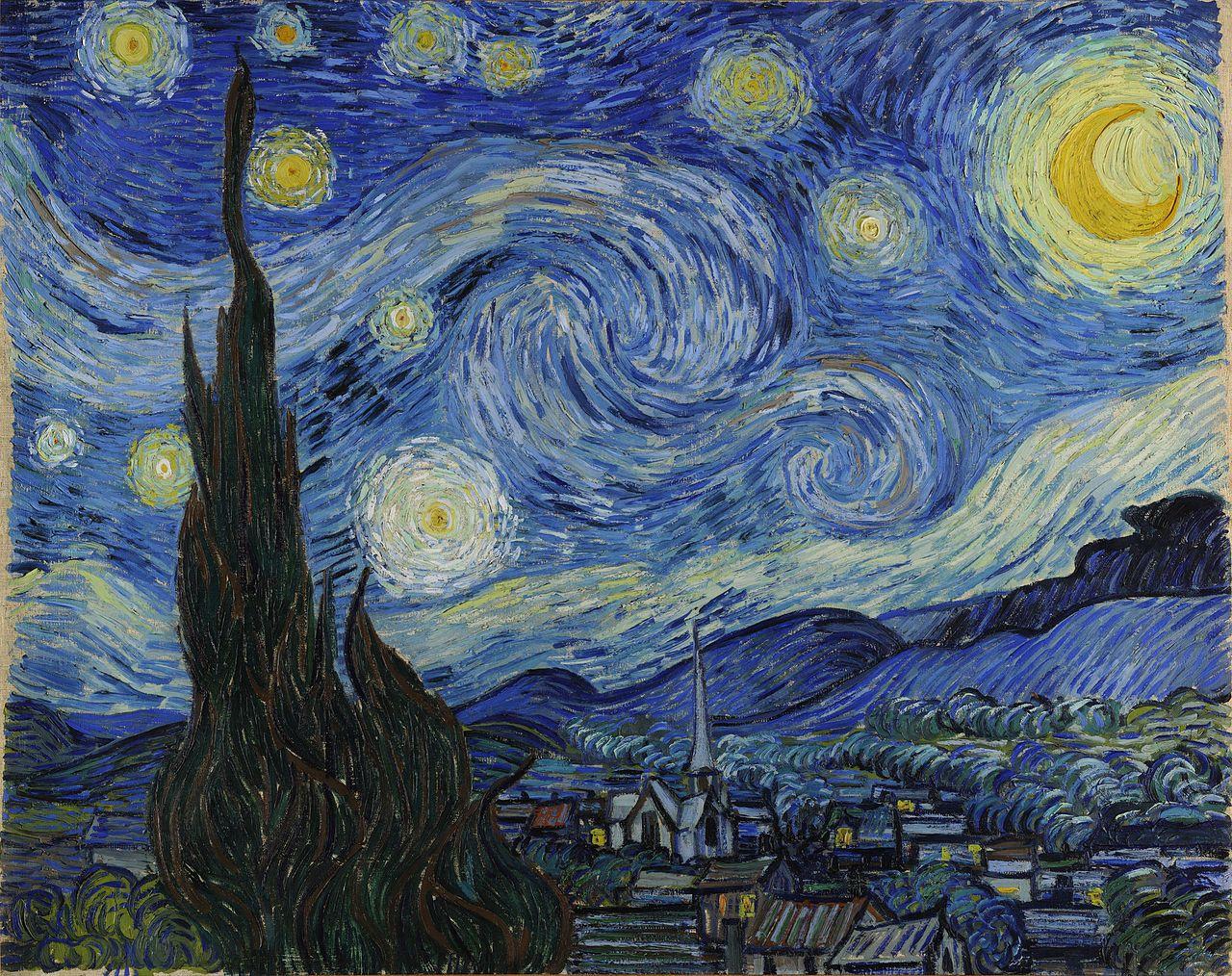
The artwork I decided to write about is called The Starry Night, and it was created by Vincent Van Gogh, a Dutch painter. It was completed in 1889 and has been permanently displayed at the Museum of Modern Art in New York City. Finally, it is a two-dimensional oil painting on canvas. It can be argued that The Starry Night successfully represents emotional overflow and the artist’s intimate experience through color harmony, balance, contrast, and unique brush strokes.
Formal Analysis
In terms of the form of art, The Starry Night is a semi-abstract landscape painting. Moreover, it was painted in oil, which is a sort of slow-drying paint that is made up of tiny pigment droplets in drying oil and spread over the canvas. It depicts a nighttime view of a little village among the hills, with a giant cypress tree coming up in the center-left. The predominant hues are blue, yellow, and emerald. In the center, there is a church with a tower rising up, while a brilliant moon hangs in the upper right corner. This piece is primarily composed of little active lines. These thin, flowing lines establish a rhythm with the spirals and minor curves by directing the eye over the sky.
The Starry Night‘s composition encompasses several design techniques. With a vast cypress on the left and a little more miniature village on the right, this artwork employs an informal balance. Moreover, Van Gogh uses brilliant yellow to contrast with the dark blue in the air. As a result, the use of a massive dark object in comparison to the brilliant sky, as well as a giant bright moon as a focal point, creates emphasis.
Next, Van Gogh employed brushstrokes to portray movement in his work. The big directional brushstrokes drive one’s eye to follow patterns while conveying a sense of physical movement in the artwork. Although the star-studded night sky dominates the image plane, the furiously whirling patterns appear to sweep over its surface like waves, creating a repetition of curved shapes in work.
Critique
While looking at The Starry Night, I experienced a slight sadness and felt emotionally overwhelmed. Since Van Gogh painted this work from a mental vision, it may have added to this piece’s profound sense of mental disorientation and emotional intensity, which supports the expressive qualities of the picture I described. It appears as though he was unable to contain his emotions and that all of his frustration and passion had spilled over into this painting.
The moon and stars appear so massive that one might believe the sky is ready to fall. The cypress shrub, a usually discreet and solemn funeral plant, becomes almost ominous as it stands directly in front of the camera. It seems as if Van Gogh was inventing his world and decided to emphasize items that he believed were significant to him, even if this resulted in a skewed perspective. Finally, The Starry Night relates to the postimpressionist movement in art, which supports the hypothesis that the artist intended to depict his emotional perception rather than reality.
Conclusion
Overall, I believe The Starry Night is a successful painting due to Van Gogh’s inspiring work with color, balance, and lines, as well as the idea of conveying mental images. For example, compared to A Sunday Afternoon on the Island of La Grande Jatte by Seurat (also a postimpressionist), the piece has greater color harmony and contrast, more distinctive shapes, and more outstanding work with lights. In judging this work, others should consider the artist’s use of lines, contrast, light, and balance as criteria. In terms of these measures, Van Gogh’s style and this specific piece are original.
Reference
Van Gogh, V. (1889). The Starry Night. Web.