
Modernism vs. Postmodernism
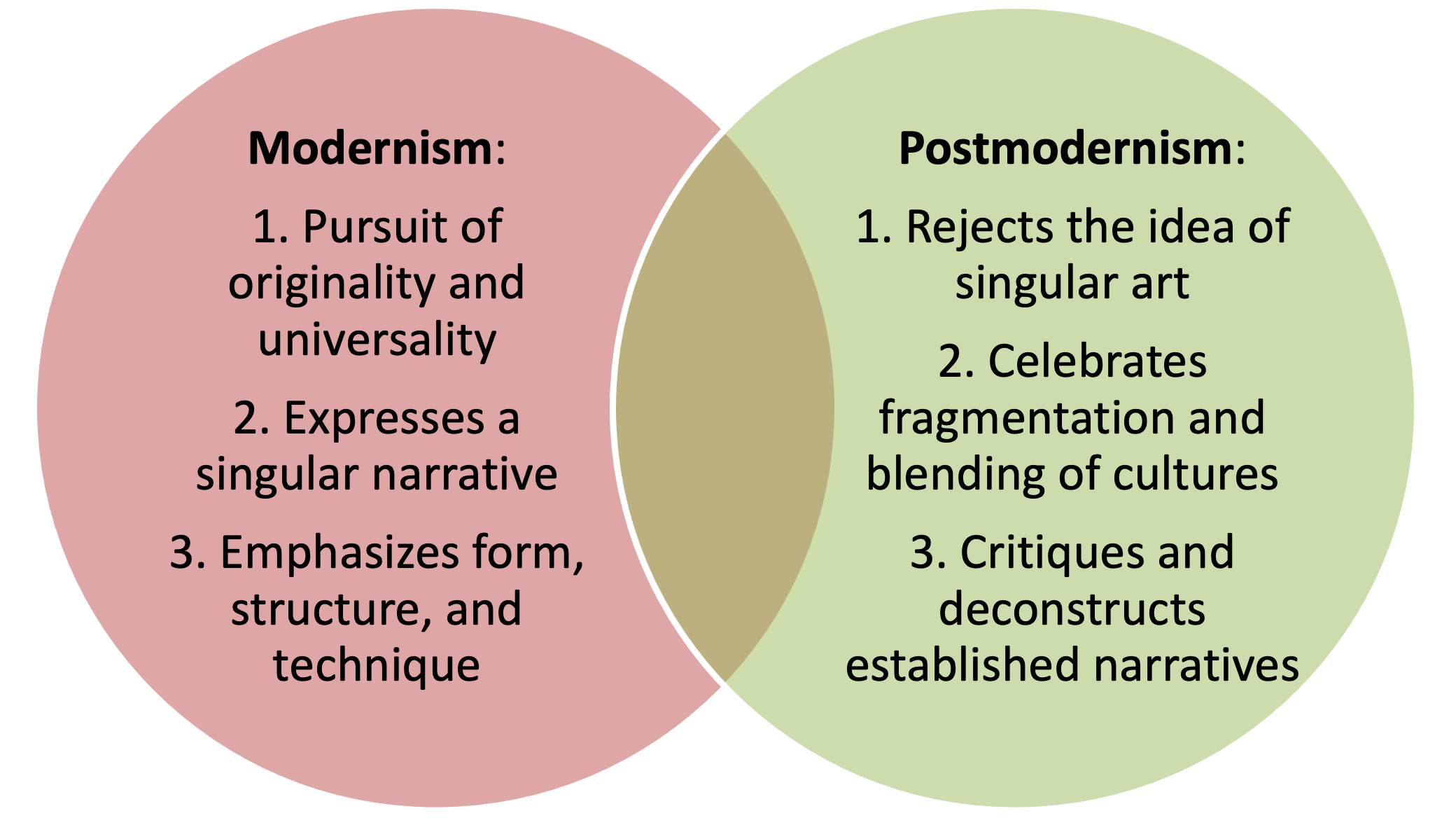
Modernism and postmodernism have something in common: they both reject the ordinary norms and traditions of art. These movements are grounded in the subjective dimension and explore the dialectic relationship between the artist and the audience. They foster and enhance experimentation and innovation to realize artistic creativity. Be it in the modernist seeking of an authentic, absolute truth or the postmodern tendency towards fragmentation and pastiche, both embody a turn away from past rigors that had suggested new paradigms.
Modernism: Kurt Schwitters’s Artwork
“Construction for Noble Ladies” by Kurt Schwitters is a work of modern art that observes the principles of modernism. The collage of 1919 contains a wide range of materials that reflect that obsession with abstraction, fragmentation, and the search for new artistic techniques. The method of Schwitters’ collages challenged the time-worn picture of representation and helped people consider what may be the limits of art and life (Schwitters, 1919). Schwitters’ innovative approach embodied the modernist quest for originality and liberation from traditional constraints on what artistic expression could be, thereby continuing to clear the path for future movements.
Postmodernism: Jeff Koons’ Artwork
The work by Jeff Koons, “Three Ball Total Equilibrium Tank,” is the absolute culmination of postmodernism and everything it rejects, all within the confines of tradition. The piece, created in 1985, consists of three basketballs suspended within a tank of water. It interrogates not only the distinction between high and low culture but also the notion and principle of artistic authorship (Koons, 1985).
The artist walks a very thin line between commercialism and high art, redrawing established hierarchies while daring the viewer to reconsider what value art may hold. His work epitomizes the postmodern accent on irony, play, and cultural critique. It reflects an end to modernism’s quest for originality in favor of the plurality of the interrelationship between art and its sociocultural context.
References
Koons, J. (1985). Three balls total equilibrium tank. Tate.
Schwitters, K. (1919). Construction for noble ladies. LACMA Collections.