
Introduction
The artistic expression of the Pacific Island cultures is inextricably tied to their celestial creation myths, especially those that talk about the universe. These fables serve as the basis of the creation stories of the islands, thereby making a permanent impression on the art and cultural heritage of the Pacific people. The celestial world is not merely a background in the myths, but an indispensable, tangible element that connects these narratives and inspires artistry and cultural civilizations. This paper aims to explore three specific examples of art from the Pacific Islands that reflect these myths: the Hawaiian Feather Cloak (ʻAhuʻula), the Moai of Rapa Nui, and the gods of Rarotonga.
The Feather Cape
This is an ancient Hawaiian garment also known as the ʻAhuʻula. It was only worn by people of high rank, especially chiefs and even warriors. In this case, every aspect of this clothing demonstrated the status of its wearer because some of the materials used to create it were scarce. Thus, the costume was considered valuable, particularly the red and yellow feathers from the i’iwi, apapane, o o, and mamo birds (see Figure 1). Some of these animals were not only endangered but yielded only six or seven suitable feathers (Kleiner, 2015).
Therefore, the craft and resources needed to knit a cloak were extraordinary because a full-length garment could require about 500,000 feathers (Kleiner, 2015). This piece of art not only served as a tool for physical protection due to its impenetrable fiber base and feather matting, but it was also believed to connect people to the spirits. The artists who made the outfit recited protective prayers and believed that the power of the sacred chants permeated the fabric lining (Kleiner, 2015). Therefore, these cloaks served as shields and also conferred the protection of the gods for the nobility.
Aboriginal cosmological beliefs are part of their traditions and are reflected through their artistry. For example, the plumage was deliberately arranged in a pattern similar to the stars and constellations, symbolizing the Hawaiian belief in their ancestors’ celestial origins (Brown, 2023). The first humans to arrive on the island of Hawai’i were Polynesians around 940 and 1130 A.D. (Westergaard, 2022). According to their belief, supernatural powers caused spirits to fill the sea before inhabiting the land, which had divinely emerged from the ocean.
Unlike geological forces, Hawaiians considered the creation of islands to be the work of the gods, thus placing people at their mercy. As for the Hawaiian people, they are believed to be descendants of the deities. They belonged to the noble class who controlled living beings on those lands, as well as all creatures that inhabited them.
The birds were allied to the gods and believed to be the gods’ incarnate (Westergaard, 2022). Therefore, feathers were the most sacred items in the Aboriginal culture. Therefore, ʻahuʻula was worn by people of high status to visualize their connection to the gods and used to cover objects of the highest importance in ancient Hawai’i.
Row of Moai
The Rapa Nui people are famous for their Moai, stone statues, which are situated across the island. These statues are tall and usually placed on stone pedestals. The monolithic Moai depict human figures with distinctive facial features. These monumental statues with an iconic style were created from volcanic stone on Easter Island between 1250 and 1500 (Kleiner, 2015).
The majority of the Moai include massive, square figures with rather flat faces, big staring eyes, firm chins, long noses, and stretched earlobes (see Figure 2). Some of them have pukao, small red scoria cylinders made of local volcanic stone that serve as hats. Moais are said to portray the ancestry of the people. The portraits are about 50 feet tall and weigh about 100 tons (Kleiner, 2015).
The Moais are positioned on sacred ceremonial platforms referred to as the ahu. Despite the different exact mythological interpretations of beliefs associated with this artwork, many legends about Rapa Nui state that the Moai are the statues of their revered ancestors. They were built to worship and mediate between these deities and the physical world.
The Easter Islanders have a rich mythology that comprises an inception story and the origins of their society. According to their creation myth, Make-Make, the Rapa Nui people’s supreme being, created the earth. He then decided to populate it after realizing something was missing. The god wanted a new being that was just like him, one who could think and talk. However, after various attempts, Make-Make fertilized the earth and created a man, and later created a woman from his rib (“Myths and Legends”, 2024). The god is not only viewed as a creator of the world but also associated with fertility and abundance, especially in terms of food.
In this regard, Moai sculptures are not merely portraits but rather generic images that Easter Islanders believed could accommodate the spirits of this god. The statues themselves are thought to have magical powers that heal spiritual ailments (DeGroot, 2024). The Moai serve as both remarkable examples of Polynesian art and one of the greatest mysteries in the world. These arts are thought to have been constructed by the descendants of the Rapa Nui as a tribute to their ancestors and deities.
Staff God of Raratonga
The main feature in this artwork is a towering central wooden post. This figure is wrapped in a large, rolled barkcloth covered with red feathers and small pieces of shell called manava, or the spirit god (British Museum, n.d.). The sculpture, which is also called Tangataroa, is a principal personality in Rarotonga mythology and traditions.
It is a vertical wooden carving that typically features human figures at the top, intricately carved and decorated with symbolic designs. These designs are a representation of the Aboriginals’ belief in the cosmic order, which stresses the close link shared between humans, gods, and the environment. Figure 3 is one of the smaller but best-preserved illustrations of the Polynesian creator Tangaroa. The head figure takes up approximately one-third of the sculpture, and its eyes are incredibly wide (Kleiner, 2015).
It is one of the few examples of the pre-Christian religious view of the central islanders. Art was used during religious ceremonies; it was carried upright on a litter, which symbolizes significance in rituals. Thus, the staff of the god’s sacred purpose highlights its role in connecting the natural world with the celestial world.
This was a powerful idol in the Cook Islands Māori, especially in the Rarotonga traditional belief system, which accounts for their creation and perpetuation in the world. The artwork features a human-like face atop the sculpture, representing the connection Aboriginal people have with the celestial world (Kleiner, 2015). For example, the shape of the art is similar to a spine and comprises seven figures with alternate frontal and profile heads. There is a high possibility that they symbolize the successive generations of people created by Tangaroa (Kleiner, 2015). The descriptions imply that these humans are derived from the god’s body.
In addition, the notching and the sequence of the central figure’s spine reinforce the close genealogical connection between humans and their gods and the environment (The Metropolitan Museum of Art, n.d.). Some figures have erect phalluses, while others depict women in childbirth (British Museum, n.d.). These features may symbolize sexual reproduction, which guarantees continuity for many generations to come (Kleiner, 2015). Although Christians converted Islanders and destroyed their idols, these artworks are integral to their myths of creation and heritage.
Conclusion
The examples of works of art provided demonstrate the significant link between Aboriginal creation myths and art from the Pacific Islands. According to these narratives, the celestial realm is not only the background of the myths but also an essential part of their being, influencing the arts and traditions. Hawaiian Feather Cape, Rarotonga sculpture, and Moai, among others, are ways in which these myths can be seen in Pacific Islands art, indicating their deep spiritual and cultural value. With these artistic expressions, people get to know more about how the Aboriginal world perspective is intertwined with their spiritual and natural world. Thus, such artworks express respect for tribal gods and the ancient stories of creation, which have given Aboriginal peoples their cultural and ethnic identities. These sculptures are not only relics but also a bridge to the past, a symbol of a creative power that has made the Pacific Islands and their people exist.
References
Brown, M. A. (2023). Indigenous religion of Hawaiʻi. Oxford Research Encyclopedia of Religion, 1-20.
DeGroot, D. (2024). Fascinating Easter Island facts and the history of the Moai statues. Safe Smart Living.
Kleiner, F. S. (2015). Gardner’s art through the ages: Backpack edition, book E: Non-Western Art Since 1300 (15th ed.). Cengage Learning.
Myths and legends of Rapa Nui. (2024). Rapa Nui Travel Guide.
The British Museum. (n.d.). Staff god.
The Metropolitan Museum of Art. (n.d.). Staff god.
Westergaard, G. (2022). Hidden stories of extinction: Hawaiian ʻahuʻula feather capes as biocultural artefacts. Museum and Society, 20(1), 104–117.
Appendix
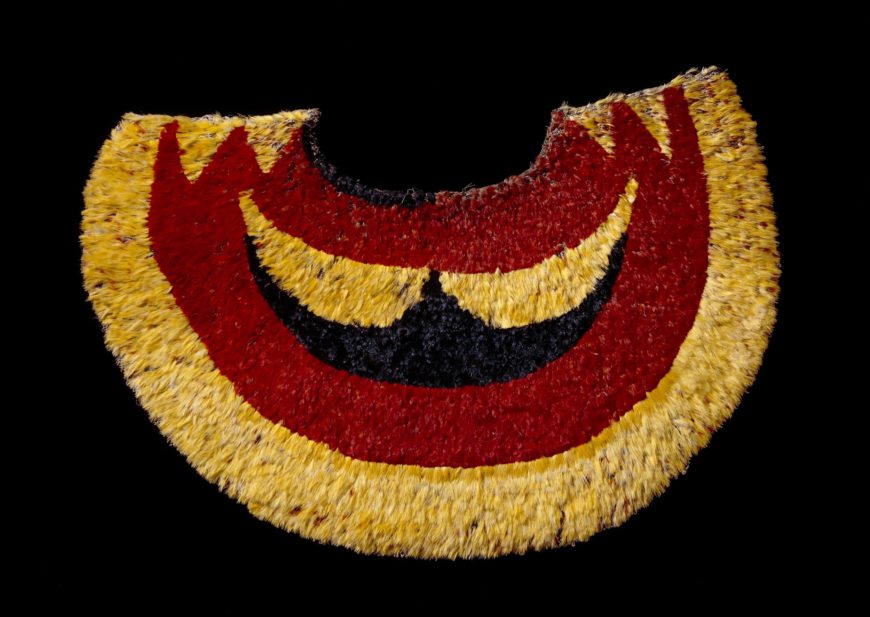
Title: Feather Cloak (‘ahu ‘ula)
Artist: Unknown
Date: 1824-1843.
Medium: Red feathers (’i’iwi), yellow and black feathers (’ō’ō), fiber (’olonā)
Location: Pauahi Museum, Honolulu
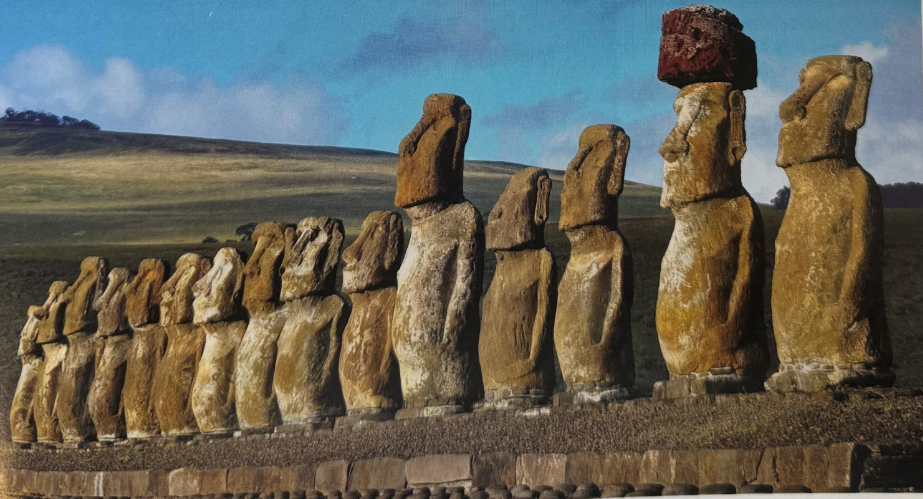
Title: Row of Moai
Artist: Unknown
Date: 1200-1500
Medium: Stone
Location: Chile, Rapa Nui (Easter Island)

Title: Staff god
Artist: Unknown
Date: 1900
Medium: Wood
Location: Cambridge University Museum of Archaeology and Anthropology, Cambridge.