
Definition of the Topic
The 2007-2008 global financial crisis is still considered one of the most critical economic cataclysms of modern times, provoking broad debate and intense scrutiny. The assertion that “reckless bankers caused the recession” reflects a widely held view that most bank losses are due to the irresponsible actions and decisions of their executives (Amadeo, para. 2). Here, the focus is on the role of actors in the economic sector in the catastrophe caused by risky lending practices, over-leverage, and the creation of complex financial products. The phrase “reckless conjurers” brings images of thoughtlessness, single-mindedness, and even unethical decisions that are bringing down the entire system.
In this regard, the presentation of bankers as reckless highlights a view of them as being careless and indifferent about the future effects of their decisions. The term includes all behaviors, from subprime mortgage lending practices that characterized the period before the catastrophe to speculative trading activities that amplified market volatility. Such a framing signifies a shift from a risk-management principle to maximizing short-term profits, often at the expense of systemic stability (Duignan, para. 6). By highlighting bankers’ actions, this approach underscores the role of financial sector actors in fueling the events that culminated in the global monetary crisis.
Recklessness of Bankers
The global financial crisis of 2007-2008 was a complex event with multiple factors, but it cannot be denied that the irresponsible behavior of bankers contributed significantly to its occurrence. Nevertheless, to comprehend the magnitude of the disaster, one must dig deeper into the broader context of regulatory failures, market dynamics, and the systemic nature of the monetary framework. The multiplication of subprime mortgage lending in the United States was at the core of the catastrophe. Banks guided by a profit motive loosened lending standards and supplied subprime mortgages to borrowers with low credit histories(Loo para 4). Hence, these subprime mortgages were assembled into sophisticated economic instruments called mortgage-backed securities (MBS) and offered to investors worldwide.
The appetite for these securities was insatiable, driven by the notion that housing prices would continue to rise. Failures and negligent supervision aggravated such irresponsible behavior by bankers. Elected bodies like the Securities and Exchange Commission (SEC), which do not sufficiently control the industry, continue harmful practices. Moreover, credit rating agencies that were supposed to evaluate the riskiness of these securities assigned them high ratings, even though they were very risky (Loo, para 3). Moreover, the industry has become more interconnected via complex financial instruments such as Collateralized Debt Obligations (CDOs) and Credit Default Swaps (CDS).
Subprime Lending and Securitization
At the core of all the issues lie subprime mortgages and risky loans made to borrowers with poor credit backgrounds. Seduced by the opportunity to own a home, many took out loans with adjustable interest rates that started low but could rise, making sustainability difficult. Banks quickly provided these loans, at times relaxing lending criteria, to bundle into elaborate financial products known as mortgage-backed securities (MBS) (Alexakis et al. 10). They were sold to investors globally as low-risk assets.
In 2007, when house prices peaked and then plunged, many subprime borrowers defaulted. The interdependence of the financial system implied that losses cascaded, since default in one area led to collapse in another. The value of MBS crashed, eliminating investments of more than half a billion and eating into bank capital. The Crisis Investigation Committee Report (FCIC) found that “forced neglect of regulations, supervision, and its oversight” has been the main cause of risky mortgage lending.
Deregulation and Shadow Banking
As a result of regulatory loosening aimed at encouraging financial innovation before the crisis, unintended consequences emerged. Shadow banking, a web of activities outside conventional banking regulation, expanded rapidly, engaging in sophisticated financial operations such as credit default swaps, thereby building up systemic risk. The lack of supervision in shadow banking facilitated highly leveraged, risky behavior, exacerbating the catastrophe following the collapse of the subprime markets (Botta et al. 170). Credit default swaps, supposedly created to mitigate risk, actually exacerbated it as insurers struggled to meet their obligations when defaults began to soar. A central message of the Federal Crop Insurance Corporation (FCIC) report is that deregulation and a poor perception of risk played major roles in the disaster.
Ratings Agencies and Misaligned Incentives
Credit rating agencies, required to assess the risk inherent in financial institutions, have performed better than other rating agencies. Charged with overstating ratings of subprime-backed securities to generate fee income, unadjusted for the risks they entailed, they misled investors and enabled the opacity of the financial markets. Deceptive ratings increased demand for MBS, leading investors to believe they were safe, thereby fueling the housing bubble and raising the risk that those MBS would default when the bubble burst (Buallay et al. 680). The FCIC report points out the “conflicts of interest” of credit rating agencies and their “significant contribution” to the intensification of the crisis’s effects.
Monetary Policy and Asset Bubbles
The early 2000s low interest rates, undertaken by central banks to stimulate the economy, are attributed by others as a trigger for the crisis. The low cost of money-fed bubble assets, even in the housing market, prompted heavy borrowing and overexposure. The role of low interest rates remains debated, yet they certainly created an environment in which financial excesses occur and asset prices keep rising unsustainably (Buallay et al. 685). The FCIC report admits the contribution of monetary policy, but concludes that low interest rates fueled the housing bubble and were not the main cause of the catastrophe.
Global Imbalances and Current Account Deficits
Global imbalances, specifically sizeable current account deficits in the United States and emerging economy surpluses, also mattered. The US funded its deficit by borrowing from abroad, thus increasing demand for its financial assets, including MBS. When the crisis struck, worldwide capital flows were reversed, which worsened the strains. These disproportions induced interdependencies and susceptibilities in the economic system.
The USA’s disaster quickly became worldwide due to high monetary integration (Botta et al. 174). The IMF highlighted that worldwide disparities have triggered the catastrophe, pointing to the intertwined nature of the mechanism. This crisis has shown the deep interconnectedness of economies across borders.
Lack of Transparency and Communication
Unclear financial products, complex risk management models, and inadequate communication created an inability to grasp the real risks within the system. The latter precluded regulators and market participants from adequately disclosing and handling new weaknesses. The multidimensional and intertwined structure of the framework, along with inadequate transparency, has contributed to the escalation of the crisis (Botta et al. 178). Limited knowledge of the risks made predicting and controlling the cascading effects of failures hard. The FCIC report puts the spotlight on “greater transparency and accountability” of the monetary sector to avoid such crises in the future.
Subprime Lending and Securitization
Lending to customers with low credit scores, or subprime lending, started the world financial crisis. Under the false impression of large profits, banks rashly issued mortgages to borrowers who had little chance of repaying them. Then, these mortgages were pooled, packaged as MBS, and sold to investors, often with manipulated credit ratings.
Credit rating agencies, paid by the banks, erroneously assessed the risk of such securities, giving them a rosy outlook for safety (Kim et al. 100). Thus, such investors, including pension funds and some financial institutions, must invest more in these products, assuming they are secure. With the housing bubble burst and homeowners cutting off their mortgage payments, the value of these securities tumbled, causing a frenzy in the financial markets.
Predatory Lending
Predatory lenders used unfair and dishonest techniques to choose their victims, who were low-quality borrowers, making the financial crisis worse, practically before it had started. Banks focused on profit maximization and implemented practices such as pushing borrowers into high-interest loans, charging excessive fees, and failing to disclose the full costs and risks of loans. These practices singled out subprime borrowers belonging to the low-income and minority groups who did not qualify for conventional mortgages, thus getting them into unsustainable loans with unfavorable terms (Kim et al. 110).
Thus, such borrowers have not repaid these loans, leading to an enormous wave of foreclosures that has undermined the housing market. Moreover, the spread of exploitative lending practices undermined trust in the monetary system and severely damaged the social fabric of the communities affected by the catastrophe.
Excessive Leverage
The overuse of indebtedness by banks played a crucial part in the development and severity of the global financial crisis. Banks borrowed enormous sums to finance their operations and investments as they were driven to generate large returns. By investing the money they borrowed, banks were able to increase their potential profit from the market through pressure (Park and Kim 6).
However, leverage also magnifies losses, making banks very vulnerable to market downturns. Following the housing bubble burst and the significant decline in the value of mortgage-backed securities, banks suffered huge losses on their investments, thereby adding to the financial problems and ultimately leading to the downfall of some major institutions (Park and Kim 6). Besides, the interdependent nature of the economic system meant that the collapse of one institution would trigger a domino effect. These ripples would spread throughout the system, enflaming panic and instability.
Short-Term Profit over Long-Term Sustainability
The single-minded quest for short-term gains and the disregard for sustainable operations were characteristic of the irresponsible behavior of banks before the onset of the global financial crisis. The banks’ activities were stimulated by pressure from their shareholders and the prospect of handsome bonuses (Park and Kim 6). This encouraged them to engage in risky, speculative activities that favored immediate profits over the sustainability of the monetary system. Banks were flying in the face of prudent management and, instead of keeping their assets and investments under control, invested more and more, blind to the signals of an imminent catastrophe.
Off-Balance Sheet Activities
Banks’ use of off-balance-sheet operations, for instance, the manufacture and sale of intricate financial products such as credit CDS, was one of the critical elements that contributed to the escalation of the recent monetary turmoil. More specifically, off-balance-sheet activities enabled banks to engage in high-risk investments without fully disclosing the size of their exposure to investors and regulatory agencies (Kim et al. 104). The banks could hide what and how perilous their health was, and the risks they were taking, by keeping these activities off their balance sheets. The opacity not only misleads investors into believing that banks are less risky than they actually are, but also makes it more difficult for regulators to monitor and mitigate systemic risks.
Other Contributing Factors
The overly simplistic approach would be to hold bankers solely responsible for the global financial crisis, because other factors also played a part. A key factor was the regulation of light touch and supervision of banks. The regulatory authorities, such as the Securities and Exchange Commission (SEC) and the Federal Reserve, were supposed to supervise and regulate the industry. Yet, they still needed to do so (Goforth 650). This allowed dangerous practices to spread without even a single hit. The lack of oversight created a situation in which banks confidently felt emboldened to act out wildly, as there was a small likelihood that negative actions would lead to consequences.
Another reason was the securitization process, which created misaligned incentives within the industry. Securitization entails pooling loans, such as mortgages, into securities, which are then sold to investors. The introduction of securitization has spread risks and increased financial market liquidity; in addition, it incentivizes lenders to focus more on the number of issued loans than on their quality (Amadeo para 4). It led to an overgrowth of subprime mortgages and other risky lending as lenders sought to meet demand for securitizations.
Flaws in credit rating agency judgments also contributed significantly to the crisis. The major credit rating agencies, such as Moody’s and Standard & Poor’s, assigned high ratings to mortgage-backed securities and other complex products despite their inherent risks. Investors used these ratings as gauges of creditworthiness, which led them to underestimate the dangers associated with this type of security (Amadeo, para. 2). This gave a false sense of security, leading to the rapid spread of toxic assets through the financial system.
Government-sponsored enterprises, including Fannie Mae and Freddie Mac, were encouraged to expand homeownership opportunities, especially for low-income and minority borrowers. This led to a softening of lending standards, as lenders complied with the government’s affordable housing targets amid a surge in subprime mortgages (Herrera et al. 534). Furthermore, the borrowers have been directly involved in the catastrophe; for instance, they knowingly accepted too much debt.
Economic Indicators
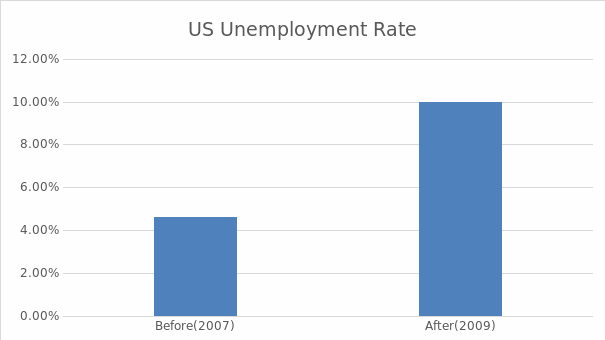
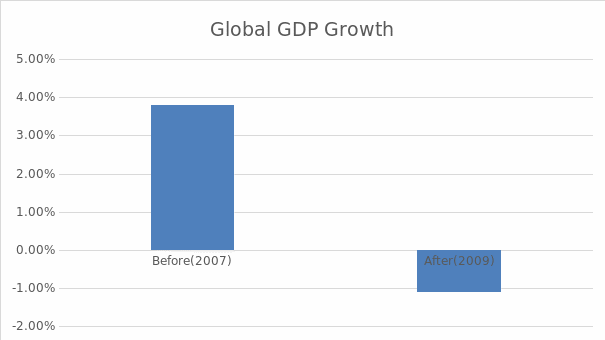
Before the global crisis, the financial picture showed a thriving global economy with low unemployment rates and a sharp rise in family obligations in a few select nations. The global GDP was growing at a healthy 3.8% in 2007, but the US unemployment rate was a pitiful 4.6% (World Bank Open Data para 1). However, following the crisis, the situation took an unusual turn due to widespread job losses, company closures, and a global financial downturn, resulting in a negative GDP growth of -1.1 percent in 2009, as seen in Figure 2 (McEvoy para 1). Figure 1 illustrates how the US unemployment rate skyrocketed to 10.0% as countries implemented emergency response plans to mitigate the crisis’s consequences, while increasing government obligations.
Conclusion
In conclusion, the global financial crisis of 2007-2008 was complicated, with several interconnected causes. However, the greed of bankers had, without doubt, a significant part to play in its coming and devastation. The term “reckless bankers” includes several actions, such as subprime lending, excessive Leverage, short-term profit-making, and the creation of seemingly opaque instruments. These actions were propelled equally by greed, lax regulation, and internal inadequacies within the monetary industry.
To blame reckless bankers only while overlooking the complex systemic failure would be an oversimplification; however, their actions were pivotal. The leading causes of this carelessness should be tackled through law reforms, bringing greater transparency and accountability to the economic mechanisms, and moving towards sustainability and resilience in the economic framework. By learning from the past, professionals can aim to prevent similar crises in the future, thereby helping create a more stable and just worldwide economy.
Works Cited
Alexakis, Christos, et al. “Performance and productivity in Islamic and conventional banks: Evidence from the Global Financial Crisis.” Economic Modelling, vol. 79, 2019, pp. 1–14.
Amadeo, Kimberly. “Causes of the 2008 Financial Crisis.” The Balance, 2022.
Botta, Alberto, et al. “The macroeconomics of Shadow Banking.” Macroeconomic Dynamics, vol. 24, no. 1, 2019, pp. 161–190.
Buallay, Amina, et al. “Intellectual capital efficiency and Bank’s performance.” Pacific Accounting Review, vol. 31, no. 4, 2019, pp. 672–694.
Duignan, Brian. “Financial Crisis of 2007–08.” EncyclopædiaBritannica, Encyclopædia Britannica, inc., 2020.
Goforth, Carol R. “Regulation of crypto: Who is the Securities and Exchange Commission protecting?” American Business Law Journal, vol. 58, no. 3, 2021, pp. 643–705.
Herrera, Helios, et al. “Political booms, financial crises.” Journal of Political Economy, vol. 128, no. 2, 2020, pp. 507–543.
Kim, Hakkon, et al. “Financial crisis, Bank Diversification, and Financial Stability: OECD countries.” International Review of Economics & Finance, vol. 65, 2020, pp. 94–104.
Loo, Andrew. “2008-2009 Global Financial Crisis.” Corporate Finance Institute, 2023.
McEvoy, Olan. “Great Recession: Global GDP Growth 2007-2011.” Statista, 2024.
Park, Hyoungkun, and Jong Dae Kim. “Transition towards green banking: Role of financial regulators and financial institutions.” Asian Journal of Sustainability and Social Responsibility, vol. 5, no. 1, 2020.
Reserve Bank of Australia. “The Global Financial Crisis: Explainer: Education.” Reserve Bank of Australia, 2023.
“GDP Growth (Annual %)“. World Bank Open Data, 2024.