
Introduction
Increased calls to raise academic standards in the education sector aim to address performance gaps in the current system. Proponents of the Standards-Based Reform (SBR) strategy have advanced this point of view. They believe that increased academic rigor, especially in terms of teacher input, could be achieved through higher academic standards (Pak et al., 2020). The Board of Education and State Regents have embraced this idea and are now pushing for nationwide adoption of SBR (Bolden & Tymms, 2020; Pak et al., 2020). However, to achieve its goals, tools for curriculum development should be discussed.
In terms of technical adaptability, access to tools and resources is essential in ensuring teachers are empowered to deliver new SBR goals. In this regard, some teachers advocate increased availability and access to educational tools as the missing link to improved performance (Bolden & Tymms, 2020). By contrast, others argue that teachers need adaptive, not technical, skills to meet the objectives of the new SBR learning framework.
The approach proposed by the first group of experts is linked to the philosophy of Winston Churchill, a former American President, who argued that resource availability was the primary factor in winning the First World War (OECD, 2023). Based on this philosophy, Churchill told the Allied forces to support the US with resources, stating that it would get the “job done” (OECD, 2023). Teachers are using the same approach to highlight the need for resource availability to meet the objectives of the SBR. For this call, the following steps may be followed when implementing curriculum changes to accommodate SBR goals.
Steps to Implement the Plan
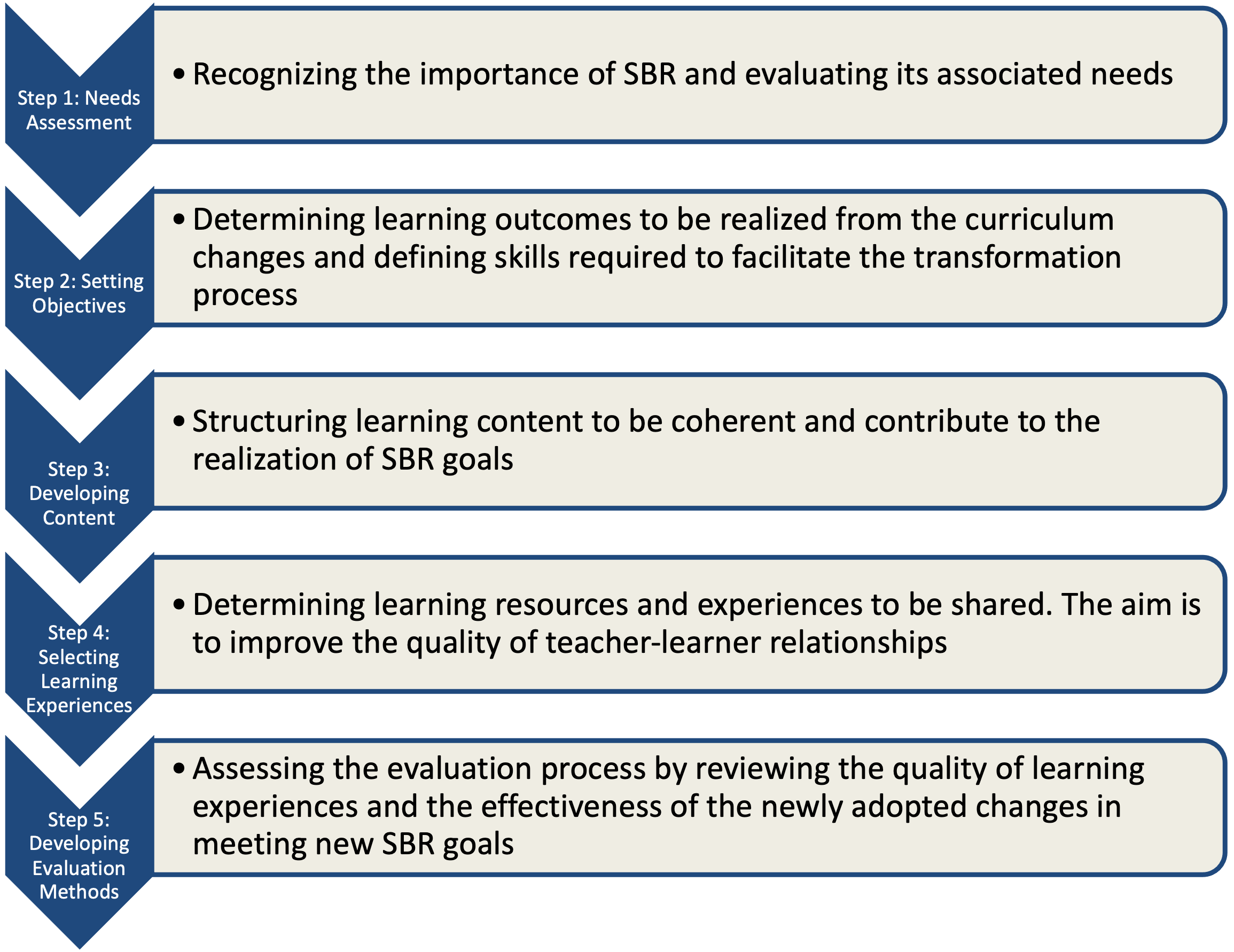
As highlighted in Figure 1 above, the process of implementing the new curriculum plan involves five key steps: needs assessment, objective setting, content development, selecting learning experiences, and determining evaluation methods. The relationship between these steps in the curriculum development process and the realization of SBR goals is moderated by factors that affect student performance in the learning environment.
A book by Terhart (2011) noted that the main factors impacting successful teaching and learning were the student, the student’s home environment, the institutional setting, teacher input, curriculum structure, and teaching methods. The latter was found to have the strongest impact on successful teaching and learning. Therefore, the impact of the five steps outlined above on teaching methods should be prioritized during implementation. In other words, teachers’ views on curriculum implementation should be given priority in decision-making.
The call for teachers to be equipped with the skills to implement SBR goals aligns with the nature of the five steps outlined in Figure 1 above. All of them require significant resources to implement the transformational changes required to realize the proposed SBR changes (Ajjawi et al., 2021). Therefore, Churchill’s call is legitimately pursued in this educational context. The justification for including this philosophy in the practical educational environment lies in the need to recognize the importance of meeting resource requirements for implementing new lesson plans.
For example, step 2 of Figure 1, highlighted above, involves determining the skills required to effect the proposed changes. These new skills will span the scope of cloud computing services and remote learning – skills that can only be implemented when students have the required resources to facilitate learning in the contemporary school setting. Therefore, Churchill’s call to action requires that teachers be equipped with the tools and resources to implement curriculum change.
Tools Required
Overall, the implementation plan for the proposed SBR framework above requires an in-depth understanding of the intricacies surrounding the curriculum development and implementation process. Notably, the process requires an in-depth understanding of the technical and adaptive aspects of leadership development (Terhart, 2011). The failure to include both aspects of governance in decision-making may lead to perennial adaptive problems in the school setting (Ajjawi et al., 2021). Therefore, it is important to have appropriate tools for strategic implementation to realize the intended goals of SBR.
Broadly, transformational software tools such as CurricuPlanner, TeachFlow Pro, and LearnCraft are appropriate for facilitating the implementation of the new curriculum directives. These software tools will help teachers design curriculum processes, manage internal systems, and better adapt to the implementation process (Scott, 2021). The tools can automatically stay up to date, making them easier to operate. However, teachers should ensure their operational plans align with existing educational standards to avoid inconsistent approaches.
Resources Required
Cloud-based resources are critical to implementing the proposed curriculum development process. This resource is critical because the proposed changes should be implemented in a policy environment that prioritizes remote learning (Pak et al., 2020). Cloud computing services are important because of their inherent features that support learning.For example, they include collaboration tools, such as video calling, that facilitate real-time communication between teachers and students.
These features of engagement are effective for building a database of a student’s milestones because they allow for the customization of learning methods to suit individual learners’ needs (Terhart, 2011). This individualized approach to learning aligns with the principles of constructivist theory, which encourage learners to develop and nurture knowledge from an individual perspective, grounded in their experiences and interactions in the learning environment (Scott, 2021). Therefore, it is self-enriching and bears the capability to improve over time.
The ability to access multimedia support through cloud computing services has also contributed to positioning it as a critical tool for implementation in the proposed curriculum development plan. This kind of support helps in enriching communication between learners and teachers (Ajjawi et al., 2021). At the same time, cloud-based computing resources are critical for onboarding new learners to the new curriculum, regardless of their location.
These features make cloud-based computing tools among the most important resources for implementing the new educational standards. Its significance to this curriculum development process underscores Churchill’s call, which highlights the importance of resource availability. It unlocks the potential for curriculum improvements in the education setting.
Techniques to be Adopted
Techniques for implementing new changes to the learning curriculum should be designed to incorporate aspects of both the old and the new orders. This implementation plan highlights the importance of integrating new curriculum proposals with existing learning management systems (LMS) (Terhart, 2011). This proposal emanates from the relative ease of integrating curriculum development tools with LMS (Hoque et al., 2020). Doing so has made it easier for educators to design, track, and monitor developments in learning outcomes as new changes take effect. The ability to complete all these tasks on a single platform is a significant draw for educators in the field.
Given the importance of integrating curriculum development tools into the LMS, flexibility will be a critical concept to adopt in the curriculum implementation plan. This proposal emanates from the need to integrate new tools with existing learning styles (Pak et al., 2020). At the same time, modern curriculum implementation tools that should be applied in the educational setting should be flexible enough to accommodate diverse learning styles (Hoque et al., 2020).
This is the best way to ensure that increased educational standards are effectively implemented. This approach to curriculum development will be adopted by integrating old and new learning processes in the new SBR plan. Doing so ensures that the SBR integration in the LMS addresses all implementation gaps across both old and new educational processes.
Summary
Calls to raise academic standards as a strategy for improving educational standards are timely and welcome. However, as seen from a contextual review of the findings of most educational stakeholders sampled in this study, this objective will not be achieved by simply raising the standards students must meet. Instead, there ought to be a holistic approach to implementing SBR goals, recognizing technical and adaptive inputs in curriculum implementation and educational planning.
The findings of this study indicate that teachers who are advocating for expanded resource availability and access are taking up Churchill’s call. In this regard, it is important to employ technical and adaptive skills to realize optimum results. The education sector should adopt the same philosophy when it comes to curriculum development, as both aspects of performance are critical to achieving SBR goals.
References
Ajjawi, R., Bearman, M., & Boud, D. (2021). Performing standards: A critical perspective on the contemporary use of standards in assessment. Teaching in Higher Education, 26(5), 728-741.
Bolden, D., & Tymms, P. (2020). Standards in education: Reforms, stagnation and the need to rethink. Oxford Review of Education, 46(6), 717-733.
Hoque, K. E., Bt Kenayathulla, H. B., Subramaniam, M. V., & Islam, R. (2020). Relationships between supervision and teachers’ performance and attitude in secondary schools in Malaysia. Sage Open, 10(2), 1-11.
OECD. (2023). OECD fiscal federalism studies bricks, taxes, and spending: Solutions for housing equity across levels of government. Paris: OECD Publishing.
Pak, K., Polikoff, M. S., Desimone, L. M., & Saldívar García, E. (2020). The adaptive challenges of curriculum implementation: Insights for educational leaders driving standards-based reform. AERA Open, 6(2), 1-11.
Scott, D. (2021). On learning: A general theory of objects and object-relations. London: UCL Press.
Terhart, E. (2011). Has John Hattie really found the holy grail of research on teaching? An extended review of visible learning. Journal of Curriculum Studies, 43(3), 425–438.