
Introduction
For this final research paper, Starbucks, a world-renowned brand that offers customers coffee drinks and desserts in cozy atmospheres, was chosen. Depending on the city, Starbucks tends to be present in many popular locations, such as densely populated and tourist areas, shopping centers, train stations, and airports. Strictly speaking, Starbucks is an international publicly traded company headquartered in Seattle, U.S., specializing in the retail sale of coffee, coffee drinks, desserts, and related products (Volle, 2022).
With effective marketing strategies, including unique cup signatures and attention to each customer, Starbucks has become a symbol of modern coffee culture, uniting coffee lovers across the country and beyond. Rethinking how people consume coffee, Starbucks decided to create a cozy environment where customers can enjoy coffee in different variations and renditions of the beverage and use the space as a social space where customers spend time with friends, work, or enjoy the atmosphere. Comfortable seating, multiple outlets, free Wi-Fi, and the ability to consume unlimited coffee and snacks, including unsweetened options, create an environment that keeps Starbucks establishments packed.
For an external customer choosing where to buy coffee, this occupancy can often indicate the establishment’s high quality and serve as a basis for choosing Starbucks, as people trust the coffee shop. A similar effect is observed, for example, in Japanese establishments, where queues lasting many hours signify the highest quality of goods or services and thus serve as a symbol of the most pleasant experience for the customer (Hewett, 2024). Thus, at the current moment, it is clear that Starbucks manages to win customers’ attention by offering fast coffee both on-site and takeaway and by creating a conceptual space in multiple locations in the city.
Disruptive Brand Plan
Historically, Starbucks’ journey as a world-renowned coffeehouse primarily began in 1971 when three partners from Seattle, Zev Siegl, Gerald Baldwin, and Gordon Bowkey, decided to open their first coffee shop (Volle, 2022). This decision was based on the idea of making coffee quickly while maintaining high-quality beans and allowing consumers to take the drinks to go. Thus, the brand’s first coffee shop opened in Pike Place Market in Seattle, initially offering only bean coffee and home-brewing equipment to customers at Starbucks. The partners realized that the establishment’s atmosphere and quality coffee attracted locals, so over the next few years, the company became a popular destination for residents and tourists in Seattle.
Eleven years after its opening, in 1982, the company was acquired by Howard Schultz, who had previously worked for the chain as director of marketing (Volle, 2022). The acquisition decision was driven by personal motivation and inspiration from Schultz, who saw significant growth potential in the business. With experience traveling in European countries, Howard Schultz had seen many local coffee shops and, determined to adopt the best practices of industry competitors, he proposed creating a place where people could enjoy coffee and socialize, similar to Italian espresso bars (Volle, 2022). Over time, however, conflict arose among the three founders and Schultz over a conceptual vision for the company’s strategic development, so the sale was not finalized until 1987. Subsequent aggressive geographic expansion of the brand’s network occurred over the next decade, as Starbucks expanded into other states and began opening locations across the United States and beyond.
Today, Starbucks is a globally recognized brand with locations in many countries where local consumers and tourists can purchase products. Starbucks is working to differentiate its beverage and dessert menus; for example, Japanese coffee shops will feature additional items unavailable in the United States, and vice versa (Waits, 2022). This includes collectible mugs and reusable cups that contain symbols of the city or country where the establishment is located. Nevertheless, there is a significant trend toward Starbucks coffee shops becoming less relevant for several reasons. For example, customers write,
“Asked for no foam. 1/3 of my grande cup was foam. Will go to another coffee place…” (CA, 2024).
“I’ve tried Starbucks…. It tastes AWFUL…” (CA, 2024).
“…today the lady who was working… as barista was unprofessional and doesn’t have customer value…” (CA, 2024).
In fairness, if one turns to another review aggregator, one can find similar complaints from other customers, namely:
“Went into Starbucks Barrhead Scotland, and there were only 3 tables left for walking in Customers. The balance of the tables were taken up by people on their laptops working with no drinks in front of them” (TP, 2023)
“What an absolute rip off!!! Bought a medium Americano and Latte £9.25 at Liverpool airport, never again will I waste my money, and they didn’t have any sweeteners… ” (TP, 2023)
“Thought I would try this new Starbucks in Clacton today as I have always been a big, big fan ever since using so many of them in America over the years… Extremely annoyed by what happened today!!!!! I was refused service because I was paying with CASH!” (TP, 2023)
“Arrived at the Kettering Cherry Hall branch by the police station. I ordered a large coffee & cake…In total I spent around 2.5 hours in the shop. A week or so later, I received a fine via ParkingEye which resulted in court letters and them now offering me A GOOD GESTURE SETTLEMENT OF £175!!!!! I was a legitimate customer, buying more than one coffee/drink, this is completely unacceptable and feels like a scam…” (TP, 2023)
As seen in the four reviews above, customers from different cities complain about the service and quality they receive at Starbucks establishments. Collectively, the seven reviews show that despite its worldwide fame and consistent brand, Starbucks has significant problems meeting customers’ needs and values. It is important to emphasize that only the seven negative reviews were chosen for persuasiveness, but it is clear that customers are also often satisfied with the chain’s coffee shops. At the same time, the number of negative reviews is considerable, making it impossible to ignore service problems.
However, other factors contribute to the decline in the relevance of the Starbucks brand for modern consumers. Firstly, the coffee market has seen increased competition from other brands offering lower-priced alternatives or unique products that catch customers’ attention (Torga & Spers, 2020; Rhiney et al., 2021). Previous studies have reported that customers are always looking for lower-priced products of higher quality, which may help explain why Starbucks’ higher prices are a problem from a marketing perspective (Maruchi, 2021). As shown by Asdi and Putra (2020), price is a dominant characteristic for a customer when purchasing a product or service, which means the higher prices of the coffee shop under study may create barriers to increased sales compared to competitors.
Second, because of the concept of cozy coffee establishments where people can spend time, trendy outlets often have long queues and few available tables, which is also a marketing weakness for the company compared to other establishments that offer fast takeaway coffee. Thirdly, Starbucks cannot be called an innovative company, as it has been offering largely the same classic items for decades: seasonal menus are present, but they tend to be limited in both quality and quantity. This creates a sense of limited coffee variety and can reduce customers’ loyalty to innovation. An important factor many customers complain about in Starbucks products is the poor taste and quality of the coffee. In particular, one user responded to a question about going to Starbucks this way:
“Starbucks do a ‘5 cheese toastie’ which is truly excellent and the only reason I go there…While waiting for my toastie…I often have a chat with the counter staff about how shit Starbucks coffee actually is. On a few occasions I’ve had a flask of coffee in my hand and offered it to the staff. The reaction is generally along the lines of “.OMG !!!! that’s £@&&¥ing amazing”, ‘I’ve never had coffee so rich, strong, flavoursome…’ etc My secret ? A well-known supermarket own brand, full roast, cheapest on the shelf £2/200g” (Blackwell, 2021).
Thus, based on real consumer feedback and analytical data, it is evident that despite its worldwide recognition, Starbucks has tangible problems in terms of marketing and positioning. The problem of Starbucks losing relevance to customers can be seen as a need to rethink product, pricing, service, and marketing strategies. Consequently, the company needs to take measures to revitalize its brand, increase customer appeal, and regain competitiveness in the industry. This paper aims to critically and comprehensively investigate the existing problems at Starbucks and propose marketing solutions that will promote quality growth.
Marketing Mix
Product
Starbucks is known for introducing many products that consumers tend to like; however, the marketing positioning of these products needs to change. As the analytical review above has shown, the lack of variety and the quality of the coffee drinks themselves are often disappointing. This is the reason immediate implementation of positive changes to the marketing model, particularly the product attribute, is recommended.
On the one hand, Starbucks should regularly introduce new, innovative drinks and desserts made with high-quality ingredients, including seasonal menu items. It is well known that seasonal food and beverages timed to coincide with a particular holiday increase sales and customer loyalty (Rajawat et al., 2020). Seasonal, in this context, refers to menu items that are available for a limited time and timed to coincide with events, such as Christmas, Halloween, Easter, or other holidays.
Changing how the product is presented can also be considered in this direction. It is known that for many of today’s consumers, predominantly members of the younger generation, the visual appearance of a beverage is essential, as this can serve as content for social media (Tymkiv, 2024). In other words, introducing changes to the beverage’s appearance and adding bright, eye-catching elements can serve as a predictor of increased popularity with customers, including new ones, and thus sales.
On the other hand, it is recommended to significantly expand the product range to cater to customers’ diverse taste preferences, including caffeine-free, vegan, and gluten-free versions of classic drinks. This line of work is already practiced at many Starbucks locations, but alternative offerings are often limited or unavailable to order at this time. This is a serious omission, as companies may be losing customers who prefer non-classic yet healthy drinks low in sugar and caffeine.
As stated earlier, another problem for Starbucks is the poor quality of the coffee drinks themselves , due to an ill-informed approach to their preparation and the quality of the raw materials used. In this regard, an essential factor in the product attribute of the marketing mix is improving the quality of service, be it through training or retraining staff in preparing drinks. Changing the preparation scheme and the recipe used is difficult and requires innovative strategies. It cannot be ruled out that the company will have to rearrange its supply chain to use different raw materials and grains, which may increase its short-term financial burden (Nantee & Sureeyatanapas, 2021). However, if this decision improves coffee quality, the revision strategy is worth implementing consistently and cautiously.
Price
Starbucks coffee and dessert products are currently priced differently by region and by specific beverage or product. For example, a quick menu comparison between Chicago and Texas shows that a large cappuccino (16 fl oz) costs $1.82 in Chicago. Changes in regional pricing are expected to be driven by local community well-being and adaptation of pricing policies, which makes sense, as dynamic pricing has been called a legitimate strategy (Cohen, 2020). However, it also creates problems, as domestic tourists may feel uncomfortable paying more for cheaper drinks in their own city.
To make products more accessible to a broader audience, several structural changes can be considered. Firstly, this includes introducing promotions and special offers, such as discounts on popular products, to encourage repeat purchases. In this context, a strategy for developing loyalty programs can also be considered, with points exchanged between countries and cities to increase customer loyalty and create conditions for greater engagement (Mostafa & Kasamani, 2021). At the same time, it is essential to note that simply reducing prices can hardly be called a competent and prioritized strategy for Starbucks, including preserving the brand image.
Distribution (Place)
By now, Starbucks drinks and desserts can be purchased both in offline coffee shops and through mobile delivery apps. In addition, specific categories of the brand’s products are available in supermarkets, including 7/11, where anyone can purchase cold-brew coffee drinks or packets and capsules for home brewing in a mug. This variety of distribution channels presents an opportunity to further increase accessibility and brand awareness (Sharma & Dutta, 2023).
However, there is a significant gap in this strategy: as long as Starbucks’s service quality and efficiency do not meet customer values and needs, widespread distribution will not be beneficial. Therefore, it is recommended to develop new store formats, including convenient coffee shops with work and meeting options, as well as coffee shops at checkout or significant transportation hubs – transforming the perception of what Starbucks coffee shops are like can have a positive impact on customer satisfaction through rebranding effects (Prayoga & Suseno, 2020). As with beverage formulation changes, this strategy is among the most challenging because it requires restructuring the establishments, including renovations, lease expansions, and the development of a design plan.
Promotion / Communications
Today, the brand has a strong presence in many areas of product offerings, including social media, streaming services, and billboard advertising. However, promoting products as they are currently being promoted can only be effective if the concept is rethought. Therefore, it is recommended that Starbucks continue to utilize several practical promotional strategies to attract new audiences and engage new channels.
On the one hand, digital marketing strategies such as social media and email newsletters can be used to inform customers about new products, promotions, or events. This will help blur the line between offline coffee shops and virtual brand presence, and create a closer, omnichannel connection between the consumer and the producer (Frasquet-Deltoro et al., 2021). On the other hand, it is acceptable to organize events that will attract public attention and increase brand awareness; these can be either author programs or participation in charitable foundations.
Market Segments — Current Target Market
Currently, the Starbucks audience is quite diverse, including coffee lovers, those who appreciate the cozy atmosphere of a coffee shop, those who use the space as a workplace, and loyal fans of the brand. This diversity of segments creates a favorable outlook for the company, allowing it to expand its audience and meet each segment’s needs. When a company’s broad audience is broken down into representative segments, it enables a simplified interaction with each segment, as the brand finds it easier to identify the values, preferences, and needs of each segment (Pradana & Ha, 2021). To illustrate, the segment of customers who use Starbucks spaces for work may prefer fast Wi-Fi, lower-priced coffee drinks, and access to charging devices. In contrast, the segment of dedicated brand fans appears to be more loyal, so they are willing to pay higher prices for drinks and to purchase collectibles and souvenirs; the availability of Wi-Fi and outlets probably carries less weight for this segment.
New Primary and New Secondary Target Market
However, it is essential to note that the proposed structural changes, whether through events and promotions, emphasis on innovation, and employee training, can further expand the pool of potential customers. Marketing transformations are expected to attract a youthful audience interested in innovative products and customers who value natural and vegan product choices. In addition, the expansion of geographic and digital presence is expected to increase the number of customers for whom quick service is essential.
New Primary Target Market
A new segment to expand Starbucks’ influence in the industry should be young audiences under 30, predominantly living in urban areas. The characteristics of this group are respect for active lifestyles, innovation, and modern technology – the segment closely follows what they consume. As a result, one of the most important criteria for them when choosing a coffee shop is the availability of vegan and natural products, as well as reduced sugar content in drinks, while maintaining taste and visual appeal.
New Secondary Target Market
On the other hand, a secondary segment for Starbucks could be entrepreneurs aged 25 to 45. As a rule, such customers will actively use the chain’s coffee shops as a place for work and meetings. Considering the segment’s business interests and needs, the most significant characteristics for such customers are the convenience of accommodation, the availability of organizational capabilities (Wi-Fi, toilets, outlets), and fast service. An average representative of such a segment would be a manager who has scheduled a meeting with a job seeker at Starbucks to interview for a position. Such meetings are often relatively fast, so the speed of service and coffee preparation makes sense for the manager.
Demographic & Economic Trends
Several critical demographic and economic trends support Starbucks’ need for change. First is the trend towards healthier lifestyles: as more people strive for healthy lifestyles and conscious eating, demand for vegan and natural products will increase (Arenas-Jal et al., 2020). In turn, this creates a need for Starbucks to expand its product offerings and provide customers with more choices, including natural and organic foods and beverages.
Second, there is a trend toward technological innovation and the associated changes in consumer behavior and preferences. For example, with the advancement of technology and the global digitalization of society, consumers tend to expect greater convenience and personalization in service, which may include the ability to order products online, the use of mobile apps for payment, and access to high-speed internet in coffee shops (Akram et al., 2021).
Third, the coffee market, like the fast-food industry, is experiencing increasing competitive pressures (Torga & Spers, 2020; Rhiney et al., 2021). As the power of competition becomes increasingly fierce, Starbucks’ sustainability requires constant renewal and innovation to retain existing customers and attract new ones. Fourth, macroeconomic factors, including inflation, changes in personal income, and general economic instability, can affect consumers’ purchasing power and preferences (Dekimpe & van Heerde, 2023). As a result, there is a need to adapt existing pricing strategies to help a company attract and retain more customers in a dynamic economic environment.
Analyzing the Consumer Market
Social Factors
Several consumer social factors may help support the proposed changes. On the one hand, it is the change in preferences, including an increased interest in healthy lifestyles and vegan food (Arenas-Jal et al., 2020). On the other hand, there is sociocultural change, including an increased interest in environmental sustainability and socially responsible brands (Pfajfar et al., 2022). This may push Starbucks to implement relevant changes, such as adopting eco-friendly packaging. Existing trends in social media cannot be ruled out, as such platforms are increasingly playing a significant role in shaping opinions about public brands (Li et al., 2021). For example, structural changes at Starbucks that are supported on social media may attract the attention of a wider audience.
Psychological Factors
In addition, several psychometric factors can be useful in supporting change. For example, scientific studies show that consumers often seek novelty, which means that introducing innovative drinks and products, as well as improving service at Starbucks coffee shops, can capture customers’ attention and retain their brand loyalty (Raji et al., 2024). Additionally, a sense of belonging and comfort should be considered. Since Starbucks is already associated with a cozy atmosphere, satisfying customers’ psychological needs will achieve greater loyalty and support positive change. Finally, one of consumers’ ultimate goals when visiting a coffee shop is to enjoy quality coffee and a pleasant atmosphere. Hence, the psychological drive for satisfaction can support changes that improve.
Customer Needs
It is reasonable to compare Starbucks’s current customer needs to those that could be met even more broadly to “disrupt” the market. The class of first needs should include customers’ desire for coffee (thirst and need for caffeine), the need for a cozy atmosphere, and the need for broad availability. Strategies that can satisfy even more customers and “disrupt” the market should include expanding the product mix through a more diverse menu and strengthening the loyalty program.
Positioning
Starbucks is a personal cozy in the coffee culture industry, where everything awakens senses and inspires new experiences. At Starbucks, we create not just coffee drinks but unique moments of pleasure and time together, inspiring one to do more. Through innovation and continuous learning, we ensure the best experience one can ever have in a coffee shop.
Competition
Table 1 – Comparison with a Competitor
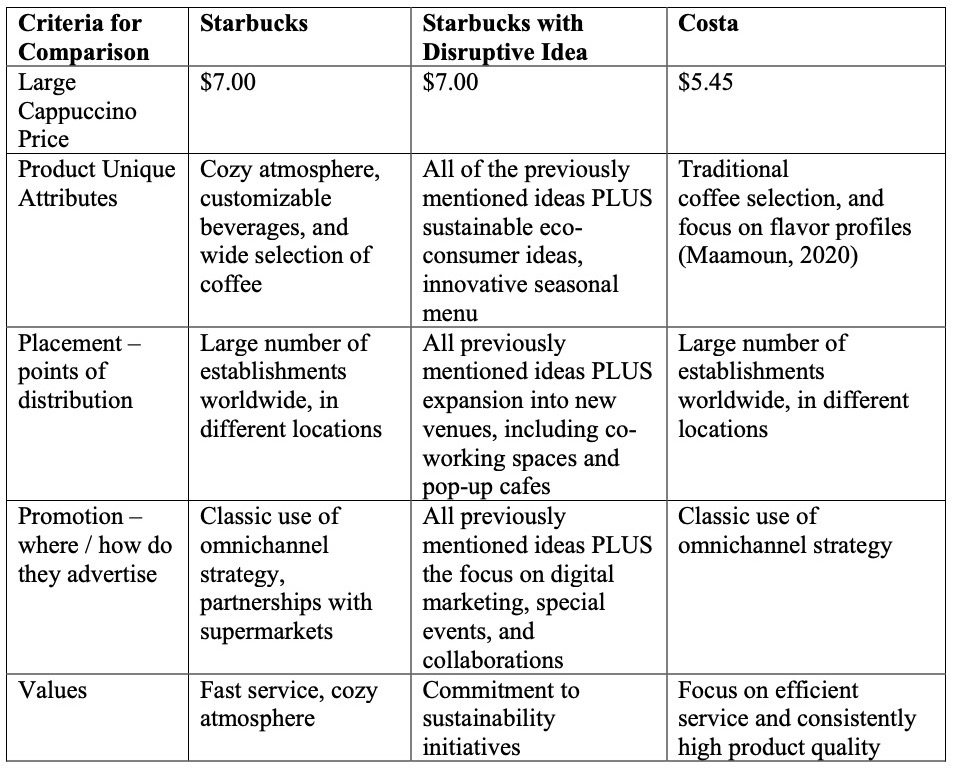
From the comparison table, Starbucks can make several changes in strategy to overcome its competitors. Firstly, it is the expansion of sustainable practices, which on a material level may include implementing better waste management systems and using recyclable raw materials (Sharma & Manthiram, 2020). Secondly, it is the introduction of an innovative menu to attract customers’ attention. Thirdly, the changes should include digital transformation whereby Starbucks can proactively develop its digital and technological capabilities.
Market Research Plans
A comprehensive statistical analysis would have been conducted for the market research, including many sequential steps. This would include analyzing the two previously named segments to identify the preferences, demands, and needs of the class’s representative members (Huang & Rust, 2021). In more detail, this could include analyzing trends in consumer behavior and market reaction to such innovations. Since Starbucks is distributed nationwide, this would have to include different regions of the United States, but the context of time is less critical. In addition, as part of the market research, it would be essential to examine competitive forces to identify advantages and niches for Starbucks’ new ideas and to borrow best practices.
Promotion Plans
Social Marketing
Due to the increasing influence of social media and digital technology, it is planned for Starbucks to focus on the direction of social marketing. This may include creating content that supports the values of sustainability and an eco-friendly approach to production — for example, how much plastic was recycled in a year and how recyclables are sanitized (Sharma & Manthiram, 2020). Thus, increasing audience engagement through social marketing is expected to help drive user engagement and increase organic reach.
Public Relations
On the one hand, developing ties with local charitable organizations will enhance Starbucks’ reputation and create an image of a sustainable and socially responsible brand. On the other hand, networking with celebrities and opinion leaders will help increase brand awareness among new audiences and attract more people to the chain’s coffee shops (Budabin, 2020). A less resource-intensive approach could be to organize Starbucks-branded themed events that would attract media and bloggers and provide free publicity.
Traditional Marketing
Meanwhile, it is recommended that Starbucks maintain and plan for effective traditional marketing to form a multi-pronged approach to strategy management. This should include standard billboards, television commercials, and print materials that can be working tools to capture the target audience’s attention. That being said, even within traditional marketing, it is recommended that Starbucks find unique and unconventional ways to manage audience interest in order to differentiate itself from the competition.
Financial Viability of Plan
By now, it is evident that introducing sustainable practices and innovative ideas in Starbucks will strengthen the company’s position in the market and attract new customers, which in turn can predict revenue growth. Since the ultimate goal of the changes being implemented is to improve the customer experience at Starbucks through taste improvements and rethinking the use of space, growing customer loyalty will lead to growth in the brand’s financial performance. On the contrary, not implementing said changes and keeping conditions and circumstances as they are today could lead to a loss of competitiveness, especially given the increasing competition in the market. Although the company has a certain amount of reputation, customer loyalty and trust cannot be infinite; hence, ignoring the changes may cause a gradual decrease in the number of consumers and people who choose Starbucks.
Relationship Marketing
Implementing revolutionary brand ideas will create more profound and meaningful customer relationships through deep consideration of audience interests and values. Introducing sustainable products and eco-friendly alternatives to Starbucks consumers will demonstrate that the company is willing to listen and positively change if the community demands it. In turn, this connection builds customers’ trust and loyalty to the brand as they see it not only as a provider of products but also as a socially responsible organization.
Socially Responsible Marketing
From a social marketing perspective, it is recommended that Starbucks invest in developing sustainability and social responsibility based on the needs and values of the audience. Practically, this can include regular participation in local charity events, partnerships with organizations dealing with social issues, and collaborations with creatives to strengthen the connection with the community (Budabin, 2020). In doing so, it is essential not only to run awareness campaigns but also to engage with audiences actively.
Christian Integration for Brand
Since Starbucks’ main goal is to serve people and do good, several strategies would allow Starbucks to be more successful in achieving Christian ideals. These include implementing (and promoting) ethical principles of honesty, transparency, and social responsibility (Keller, 2014). It is essential to keep the biblical integrations unobtrusive because the coffee shop’s audience is not only Christians, so overt displays of Bible verses or symbolism may be discouraging to atheists and adherents of other faiths.
Recommendations
From a brand manager’s perspective, based on the insights gained, several critical decisions need to be made to further develop Starbucks. First, it is essential to continue to understand the target audience’s needs and values. Second, developing (and introducing) innovative products that respond to dynamically changing market needs is necessary. Third, it is essential to emphasize building sustainability and social responsibility, which will help brand positioning and audience engagement. Fourth, diversification of marketing efforts is recommended to strengthen ties with the customer base, including through a focus on digital marketing.
Conclusion
Based on the results of the comprehensive analysis, implementing the proposed recommendations will enable Starbucks to reach new market heights. In more detail, an in-depth understanding of the target audience, innovative product approaches, a focus on sustainability and social responsibility, regular employee training, and efforts to restructure and rethink both beverage flavors and space utilization will help the brand stand out qualitatively in the market and strengthen its position. Hence, the above plans are recommended to Starbucks management for implementation as the benefits will be tangible.
References
Akram, U., Fülöp, M. T., Tiron-Tudor, A., Topor, D. I., & Căpușneanu, S. (2021). Impact of digitalization on customers’ well-being in the pandemic period: Challenges and opportunities for the retail industry. International Journal of Environmental Research and Public Health, 18(14), 1-21.
Arenas-Jal, M., Suñé-Negre, J. M., Pérez-Lozano, P., & García-Montoya, E. (2020). Trends in the food and sports nutrition industry: A review. Critical reviews in food science and nutrition, 60(14), 2405-2421.
Asdi, A., & Putra, A. H. P. K. (2020). The effect of marketing mix (4P) on buying decision: Empirical study on brand of Samsung smartphone product. Point of View Research Management, 1(4), 121-130.
Blackwell, D. (2021). Why would you go to Starbucks? What are the advantages and disadvantages of Starbucks as a customer? QUORA.
Budabin, A. C. (2020). Caffeinated solutions as neoliberal politics: How celebrities create and promote partnerships for peace and development. Perspectives on Politics, 18(1), 60-75.
CA. (2024). Starbucks reviews. Consumer Affairs.
Cohen, M. C., Lobel, I., & Paes Leme, R. (2020). Feature-based dynamic pricing. Management Science, 66(11), 4921-4943.
Dekimpe, M. G., & van Heerde, H. J. (2023). Retailing in times of soaring inflation: What we know, what we don’t know, and a research agenda. Journal of Retailing, 99(3), 322-336.
Frasquet-Deltoro, M., Molla-Descals, A., & Miquel-Romero, M. J. (2021). Omnichannel retailer brand experience: Conceptualisation and proposal of a comprehensive scale. Journal of Brand Management, 28, 388-401.
Hewett, J. (2024). How to queue for food in Tokyo. Escape.
Huang, M. H., & Rust, R. T. (2021). A strategic framework for artificial intelligence in marketing. Journal of the Academy of Marketing Science, 49, 30-50.
Keller, T. (2014). Every good endeavor: Connecting your work to God’s work. Penguin.
Li, F., Larimo, J., & Leonidou, L. C. (2021). Social media marketing strategy: Definition, conceptualization, taxonomy, validation, and future agenda. Journal of the Academy of Marketing Science, 49, 51-70.
Maamoun, A. (2020). Coca-Cola brews a hot acquisition: Costa coffee. SAGE Publications.
Maruchi, T. (2021). Factors influencing Japanese decision makers in Thailand when they purchase capital measurement equipment for automatic industry. DSpace.
Mostafa, R. B., & Kasamani, T. (2021). Brand experience and brand loyalty: Is it a matter of emotions? Asia Pacific Journal of Marketing and Logistics, 33(4), 1033-1051.
Nantee, N., & Sureeyatanapas, P. (2021). The impact of Logistics 4.0 on corporate sustainability: A performance assessment of automated warehouse operations. Benchmarking: An International Journal, 28(10), 2865-2895.
Pfajfar, G., Shoham, A., Małecka, A., & Zalaznik, M. (2022). Value of corporate social responsibility for multiple stakeholders and social impact – Relationship marketing perspective. Journal of Business Research, 143, 46-61.
Pradana, M. G., & Ha, H. T. (2021). Maximizing strategy improvement in mall customer segmentation using k-means clustering. Journal of Applied Data Sciences, 2(1), 19-25.
Prayoga, A., & Suseno, E. (2020). The positive impact of rebranding to increasing consumer loyalty with brand image as the mediating variable. International Journal of Social Science and Business, 4(4), 561-568.
Rajawat, A., Kee, D. M. H., Malik, M. Z. B. A., Yassin, M. A. Q. B. M., Shaffie, M. S. I. B. A., Fuaat, M. H. B., & Santoso, M. E. J. (2020). Factors: Responsible for McDonald’s performance. Journal of the Community Development in Asia, 3(2), 11-17.
Raji, M. A., Olodo, H. B., Oke, T. T., Addy, W. A., Ofodile, O. C., & Oyewole, A. T. (2024). E-commerce and consumer behavior: A review of AI-powered personalization and market trends. GSC Advanced Research and Reviews, 18(3), 066-077.
Rhiney, K., Guido, Z., Knudson, C., Avelino, J., Bacon, C. M., Leclerc, G., & Bebber, D. P. (2021). Epidemics and the future of coffee production. Proceedings of the National Academy of Sciences, 118(27), 1-10.
Sharma, N., & Dutta, N. (2023). Omnichannel retailing: Exploring future research avenues in retail marketing and distribution management. International Journal of Retail & Distribution Management, 51(7), 894-919.
Sharma, S. S., & Manthiram, A. (2020). Towards more environmentally and socially responsible batteries. Energy & Environmental Science, 13(11), 4087-4097.
Torga, G. N., & Spers, E. E. (2020). Perspectives of global coffee demand. In L. F. de Almeida & E. E. Spers (Eds.), Coffee consumption and industry strategies in Brazil (pp. 21-49). Woodhead Publishing.
TP. (2024). Starbucks. TrustPilot.
Tymkiv, M. (2024). Strategies for capitalizing on gen Z’s growing influence. Forbes.
Volle, P. (2022). Rhetorical history and strategic marketing: The example of Starbucks. Journal of Historical Research in Marketing, 14(1), 111-129.
Waits, K. (2022). If you find this thrift shopping, buy it. MoneyTalksNews.