
Introduction
Eco-friendly packaging solutions are a growing trend in the modern world, as many people and businesses are concerned with sustainability and their environmental impact. Traditional packaging materials, such as plastic, are becoming less popular as recycled cardboard, compostable materials, and plant-based plastics replace them (Saveth, 2023). Climate change and other environmental threats ensure that demand for these solutions will continue to grow. That is why I have decided to focus on the manufacturing of eco-friendly packaging for various stakeholders, and the company will be called EcoWrap Reusables.
I will rely on compostable materials and appropriate designs to minimize waste. The leading innovative solutions will refer to customizable design and the introduction of reuse options. On the one hand, customers can share their preferences with the company, which will then create individual designs. On the other hand, my company will encourage individuals and organizations to reach out to us and ask our delivery system to collect used packaging. This step will significantly reduce waste and provide EcoWrap Reusables with a constant influx of raw materials.
It is necessary to use Operations Management (OM) concepts to make this business successful. This phenomenon is essential because it helps design, plan, execute, and control projects and ensures that these areas meet predetermined standards (Pace, 2023). An appropriate and effective approach to this issue additionally promotes higher customer satisfaction, employee motivation, and operational performance (Pace, 2023). Thus, a detailed OM plan is presented below to explain how the suggested product can successfully enter the market.
Operations Management Plan
Operational Performance Objectives
It is necessary to develop and establish specific and appropriate objectives at the initial stage. They specify leading goals that a company is going to achieve, which allows for determining the direction of business development and where it is likely to be in the future (Kipruto & Eric, 2021). Experts focus on multiple phenomena, and the most typical options include cost, quality, flexibility, and speed (Kipruto & Eric, 2021). The following list presents and defines the leading objectives for EcoWrap Reusables, along with how they will be measured.
- Quality. Eco-friendly packaging should meet the highest standards of sustainability and durability. The company will rely on durability tests, defect rates, and customer satisfaction surveys to determine if this value is observed.
- Cost. Successful business results are only possible if EcoWrap Reusables offers a competitive pricing strategy that simultaneously maintains profitability. In this area, attention should be paid to the cost per unit and to comparing prices with industry benchmarks.
- Delivery. Products must be delivered to clients on time because this fact demonstrates that the business is reliable and consistent. This metric can be measured using an on-time delivery rate, and the absence of late orders is a good indicator.
- Flexibility. In the present world, customers prefer customization options and value individualism. Product and design ranges will help determine if this objective is met.
Product Design
Product design is a comprehensive process that involves several steps. First, market research and development are a starting point for this activity because they are necessary to investigate market demand, analyze customer preferences, and determine which packaging solutions can help satisfy these findings. One cannot overestimate the importance of this stage, as it helps determine niches that can generate future profits for the company. Second, prototyping allows the company to see and feel the intended product (Lo et al., 2021). It is possible to use prototypes to test their durability, functionality, and eco-friendliness. That is why EcoWrap Reusables should manufacture a limited volume of packaging material to investigate it.
Third, testing and validation are separate stages because these activities involve more extensive and informative procedures. In particular, it is necessary to perform quality assurance and analyze the product’s environmental impact. These activities demonstrate whether the proposed packaging can help meet organizational objectives (Lo et al., 2021). Finally, production and market launch represent the final step in this challenging process. Once all test results are satisfactory, the organization should select an appropriate, effective market entry strategy to reach target customers and overcome competitors. This description represents a professional, multifaceted approach to product design.
Process Strategy and Layout Design
This type of business should rely on a specific manufacturing process strategy. In this case, a make-to-order (MTO) approach seems appropriate because of its characteristic features. This strategy implies that a product should only be produced after an order is placed (Lizarralde-Aiastui et al., 2020). Even though this method implies a relatively long time between placing an order and receiving a product, EcoWrap Reusables can benefit from it because the company offers customized packaging. It is impossible to manufacture unique products in advance, which justifies the given selection. Furthermore, this approach reduces waste and eliminates the need to spend money on unused items.
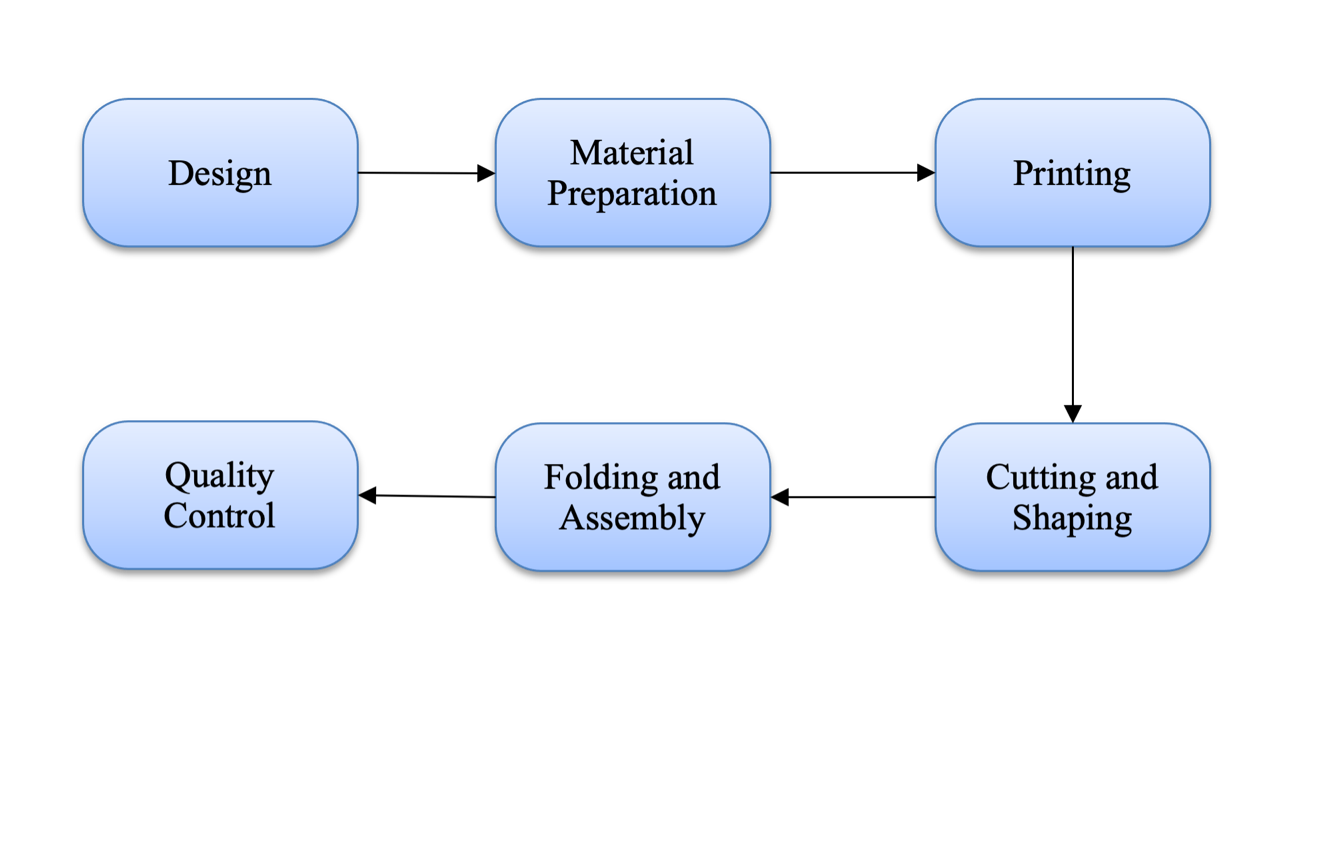
As for a layout, a cell manufacturing strategy seems suitable. It is characterized by increased flexibility and productivity and allows for meeting personalized market demand (Zhao et al., 2020). This innovative layout implies that machines and workstations should be organized into cells, each dedicated to a specific packaging size. Figure 1 below represents a cell that manufactures packages of a single size. If the company needs to use other dimensions, it is only necessary to create an identical cell with different equipment pieces and characteristics.
The visual below shows that the manufacturing process consists of six independent, consecutive stages. The process begins when customers place an order and provide all the information needed for the packaging. These steps represent a standard manufacturing process for eco-friendly, customized packages. As for cycle time, it tells how long it takes to complete an order. It depends heavily on the equipment used in the process. It is reasonable to expect that two hours will be needed to manufacture an average set of sustainable packaging.
Capacity and Planning
The company will rely on an appropriate methodology to measure capacity by focusing on two essential aspects. First, it is possible to look at output measures that refer to the amount of packaging. In particular, EcoWrap Reusables can determine the quantity of eco-friendly packaging units that it procures per day, week, or month. The obtained figure will demonstrate the business’s productivity over a limited time period.
Second, an alternative approach to measuring capacity refers to resource utilization. Managers highlight how key resources, such as equipment, labor, and raw materials, are used in the manufacturing process. For instance, it is reasonable to determine the machine uptime percentage or the labor utilization rate to assess the phenomenon under analysis. In any case, EcoWrap Reusables should understand that increasing capacity may be required to maximize profits, and the company should keep this option in mind.
It is possible to use different strategies, but tracking capacity is an optimal option. This approach denotes that an organization should carefully monitor market demand and make appropriate decisions to meet it (Liu et al., 2022). EcoWrap Reusables can benefit from this strategy because it allows the company to adjust its capacity to higher or lower demand levels. This feature provides the business with flexibility and an effective method to minimize the risk of stock-outs or overproduction. However, one should remember that the effectiveness of this capacity strategy depends significantly on the accuracy of market analysis, indicating that risks are present.
Inventory Management
An appropriate inventory management strategy is needed to support the company’s operations without violating its image. The latter statement indicates that EcoWrap Reusables is concerned with sustainability and environmental impact, and that its inventory management should align with these goals. That is why a Just-in-Time (JIT) strategy is suitable in this case. First, it implies that the organization keeps inventory levels low and requests only the raw materials needed when an order is placed (Stojkanović et al., 2021). This approach minimizes waste and aligns with the company’s image.
Second, the JIT method reduces storage requirements since there is little inventory. This fact benefits the organization because it does not need to maintain extensive storage space for excess inventory, which is often associated with additional costs (Stojkanović et al., 2021). Third, the selected strategy provides a business with greater flexibility to respond to changes in demand (Stojkanović et al., 2021). EcoWrap Reusables can easily handle such fluctuations because suppliers are contacted only after orders are placed.
However, the company should remember that the selected strategy implies some limitations. Keeping inventory levels low indicates that the organization can begin manufacturing packaging only after suppliers have delivered the raw materials. As a result, the processing time increases, which may be inappropriate for some customers.
Simultaneously, it is worth acknowledging that the stability of manufacturing processes significantly depends on suppliers’ performance (Stojkanović et al., 2021). Any delays or the provision of low-quality materials can hurt the manufacturing process and affect the company’s earnings. This description implies that EcoWrap Reusables should carefully select suppliers and work with effective, reputable contractors. In any case, one should understand that the positive aspects of this strategy outweigh the potential drawbacks, which justifies this selection.
Quality Management
Total Quality Management (TQM) seems a suitable strategy for EcoWrap Reusables because it emphasizes continuous improvement and customer satisfaction. However, a more detailed discussion of this concept shows how it benefits the company. First, TQM prioritizes a business’s commitment to quality in all stages (Abbas & Kumari, 2021). It is necessary to ensure that high-quality packaging is manufactured and delivered to customers.
Second, customer focus is another essential element of the selected approach (Abbas & Kumari, 2021). Since customers can request unique, customizable designs, a TQM approach is needed to ensure that the final products meet the highest standards and customers’ expectations. Third, continuous improvement has already been mentioned as an essential element of this strategy, but one should add that this concept is aligned with the organization’s image. Since EcoWrap Reusables focuses on innovation and waste minimization, TQM can help continuously improve processes to reach these goals.
In addition, the selected strategy advocates total employee involvement in the manufacturing process. The cellular layout described above implies that individual workers should be given the authority and responsibility to make informed decisions at different production stages. Simultaneously, employees should be empowered to propose new materials, design solutions, and process improvements, and these personal contributions will motivate them to meet high-quality standards (Abbas & Kumari, 2021).
Finally, the given approach is effective because it helps establish a good and productive relationship with suppliers. As mentioned above, the successful performance of EcoWrap Reusables depends significantly on suppliers. That is why it is necessary to find reliable contractors and maintain close connections with them. TQM is a suitable strategy that can allow the company to succeed in this area.
Supply Chain Management
A supply chain management (SCM) system should reflect the company’s focus on environmental impact and eco-friendly solutions. That is why the Green Supply Chain Management (GCSM) approach seems appropriate. Herrmann et al. (2021) indicate that this method emphasizes transportation, sourcing, manufacturing, and distribution sources that reduce environmental harm.
For EcoWrap Reusables, it is obligatory to ensure that its supply chain does not cause environmental pollution, as this would contradict its mission and values. This SCM method simultaneously highlights supplier selection and collaboration. While the previous section emphasized the importance of finding effective, productive contractors, the GSCM method holds that collaboration with suppliers who share the organization’s commitment to sustainability is necessary (Herrmann et al., 2021). Thus, EcoWrap Reusables should find contractors who incorporate environmental protection into their operations.
In addition, the selected SCM strategy is appropriate because it prioritizes energy efficiency and addresses the carbon footprint. These concepts are addressed because transportation routes are optimized to minimize fuel consumption. Another suitable strategy is to use renewable energy sources in manufacturing facilities, which significantly reduces carbon emissions (Herrmann et al., 2021).
Finally, it is worth noting that the GSCM strategy is effective in reducing waste (Herrmann et al., 2021). EcoWrap Reusables should ensure that its suppliers both deliver goods and collect used packages from the customers. As a result, waste is significantly reduced because these packaging materials are recycled and used to make future products.
Sustainable Operations
Closed-loop recycling is an effective operational strategy that can help EcoWrap Reusables generate sustainable outcomes. This approach implies that used packaging materials should be collected, recycled, and incorporated into new products (Larrain et al., 2020). This statement aligns with the circular economy theory, which stipulates that resources should be kept in use for as long as possible to reduce waste accumulation and associated costs.
It has already been mentioned that this recycling approach would be a defining feature of the company, enabling it to protect the environment. One should clarify that sustainable outcomes will be achieved if the organization establishes an effective, productive feedback system with its customers. This statement indicates that clients should know how and why to contact EcoWrap Reusables to arrange for the company to collect used packaging.
It is additionally reasonable to explain how the suggested operational strategy can be measured. In particular, a few specific metrics can help cope with the task. First, a material recovery rate focuses on the percentage of packaging materials collected from customers and returned to the company as raw materials.
Second, the recycled content percentage focuses on the proportion of recycled materials in new packaging. It is worth acknowledging that high ratios are a sign of good sustainability. Third, a carbon emission rate can demonstrate how sustainable the given organization is compared to other packaging production companies that rely on traditional manufacturing processes.
Conclusion
EcoWrap Reusables is a hypothetical business that will offer eco-friendly packaging, recycling options, and customizable designs to customers. The report presents a comprehensive operations management plan for this business. Specific attention was drawn to product design, capacity, quality management, and other significant areas.
Each of these sections provided detailed commentary on the strategies or approaches the organization should adopt to manufacture products and uphold its values. Evidence from scholarly sources was analyzed and incorporated into the assignment to ensure that the provided suggestions were reliable and supported by expert knowledge. Finally, the given operations management plan can be useful for other organizations that plan to manufacture environmental products and engage in sustainable operations.
References
Abbas, J., & Kumari, K. (2021). Examining the relationship between total quality management and knowledge management and their impact on organizational performance: A dimensional analysis. Journal of Economic and Administrative Sciences, 39(2), 426-451.
Herrmann, F. F., Barbosa-Povoa, A. P., Butturi, M. A., Marinelli, S., & Sellitto, M. A. (2021). Green supply chain management: Conceptual framework and models for analysis. Sustainability, 13(15).
Kipruto, Y. W., & Eric, N. (2021). Role of supply chain collaboration on operational performance of third party logistics service providers in Kenya. International Journal of Social Sciences Management and Entrepreneurship (IJSSME), 4(2), 232-249.
Larrain, M., Van Passel, S., Thomassen, G., Kresovic, U., Alderweireldt, N., Moerman, E., & Billen, P. (2020). Economic performance of pyrolysis of mixed plastic waste: Open-loop versus closed-loop recycling. Journal of Cleaner Production, 270.
Liu, P., Zhang, Q., Wang, A., Wen, S., & Pannek, J. (2022). Operator-based adaptive tracking capacity control in complex manufacturing processes. Applied Sciences, 13(1).
Lizarralde-Aiastui, A., Apaolaza-Perez de Eulate, U., & Mediavilla-Guisasola, M. (2020). A strategic approach for bottleneck identification in make-to-order environments: A drum-buffer-rope action research based case study. Journal of Industrial Engineering and Management (JIEM), 13(1), 18-37.
Lo, C. K., Chen, C. H., & Zhong, R. Y. (2021). A review of digital twin in product design and development. Advanced Engineering Informatics, 48.
Pace, K. (2023). What is operations management? Western Governors University.
Saveth, B. (2023). Embracing sustainability: The rise of eco-friendly packaging solutions. Forbes.
Stojkanović, D., Petković, Z., & Ivanov, L. (2021). Just in time as a modern principle of inventory management. KNOWLEDGE-International Journal, 45(1), 193-197.
Zhao, Y., Lu, J., Yan, Q., Lai, L., & Xu, L. (2020). Research on cell manufacturing facility layout problem based on improved NSGA-II. Computers, Materials, & Continua, 62(1), 355-364.