
Introduction
Integrating multidisciplinary engagement is a crucial step to enhancing healthcare services. This analysis illustrates the proactive inter-professional care measures employed across different integrative systems and their consequences for positive health outcomes (Kolltveit et al., 2024). Through rigorous analysis of journals, the investigation aims to provide insights into the transformative effects of multidisciplinary teams in healthcare and their future role in nursing practice. Some of the databases used include PubMed and other sources to retrieve the articles.
The selection criteria used adhere to the standards of scientific research, including the use of articles that consider study merit and integrity. The findings will inform future nursing practice by supporting collaborative engagements among clinicians to enhance comprehensive care coverage (Kolltveit et al., 2024). In addition, the research elucidates the diverse benefits of inter-professional care, including reduced response time, patient satisfaction, and positive health outcomes.
Key Terms
Inter-professional, multidisciplinary collaboration and teamwork are some of the keywords used in this research article. These words are interchangeable and refer to a group of clinicians, including nurses, physicians, physiotherapists, and others, who are independent in their job roles but work together to ensure quality care (Kolltveit et al., 2024). Another crucial term in the essay is ‘health outcome,’ which refers to the expected health outcomes.
In addition, the paper includes the keyword “quality of care,” which refers to the excellence in healthcare services that result in positive health outcomes and patient satisfaction (Hager et al., 20 21). Barriers and facilitators are also highlighted to illustrate the hindrances that derail the effective implementation of collaborative processes, while facilitators are arrangements or systems that enhance inclusive engagement (Hager et al., 2021). These key terms were crucial for initiating a comprehensive search for relevant literature for the study.
Literature Search Strategies
Research Questions and Justifications
This analysis aimed to examine the impact of inter-professional engagement on patients’ positive health outcomes. Therefore, different strategies were employed to analyze the best articles addressing the explored topic. Thus, the primary review questions included “How inter-professional care strategies promote evidence-based care.”The question was focused on generating articles that contain information concerning positive health outcomes. Another integral question was, “How does inter-professional care impact patient satisfaction and quality of care?” This inquiry would provide information on the different outcomes of inter-professional care, all of which enhance the quality of care.
Another important review question focused on “What are the effects of inter-professional engagement on patient health outcomes?” This focus would highlight the importance of expert collaboration in developing effective health practices to improve outcomes. In addition, another input focused on “the important models in inter-professional care that will enhance health results.
Search Strategy
The research was conducted using multiple literature search engines to ensure an in-depth analysis. Some of the databases used include Queen Margaret University Discover (QMU), PubMed articles, Sage Journals open access, and Google Scholar, in which different keywords were searched to retrieve diverse literature on the topic. Some of the keywords typed in the database included “inter-professional care,” health outcome and quality of care.”
In addition, contrasting terms were also keyed in, including “barriers and facilitators,” all of which ensured a comprehensive search. These databases yielded over 30 articles, which were analyzed for relevance and incorporated into the research. The journals and articles ensured a comprehensive analysis and data-driven results focused on this topic.
Inclusion and Exclusion Criteria
Various principles of scanning and selection were employed to ensure the literature used aligned with research standards. First, all the studies included in this research were peer-reviewed articles to ensure the validity of the summarized findings. As highlighted by Heiden et al. (2023), evidence-based research is critical in promoting the validity and reliability of research. Therefore, the inclusion criteria emphasized studies that employed scientific research methodologies, including interviews, to ensure firsthand information was obtained, thereby increasing the feasibility of the research (Heiden et al., 2023). The literature excluded from the study included articles that were not relevant to the chosen topic.
Reduction of Literature
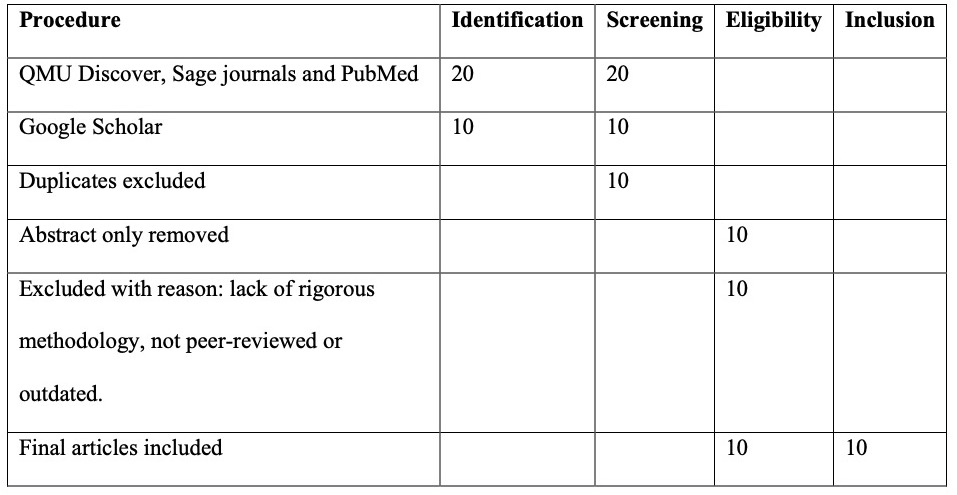
The first database search produced 30 journals focused on healthcare improvement initiatives. The papers were then screened through exclusion and inclusion criteria to ensure the documents used for the research would answer the research questions. Some of the articles excluded were duplicates or required stronger scientific methods. This strategy helped narrow the papers down to 10 articles that could address the research process.
As highlighted in Prisma Table 1 below, the main databases used were QMU Discover, Sage journals, PubMed, and Google Scholar, which yielded 30 articles during the identification stage. During the screening stage, 20 articles were removed because they were duplicates, included only the abstract, or lacked a rigorous study design. The comprehensive data extraction process is captured in Appendix 1 below.
PRISMA Table 1: Literature Selection Process
Review of Articles
Inter-Professional Engagement and Evidence-Based Care
Multidisciplinary engagement fosters collaboration among experts to ensure the highest quality of patient care. Donnelly et al. (2021) explain that collaborative engagement is crucial for enhancing the quality of care provided, thereby helping reduce healthcare complications in emergencies. The researchers employed an observational cross-sectional design to analyze 445 surveys completed by Inter-professional primary care (IPC) participants who responded to the COVID-19 pandemic (Donnelly et al., 2021).
The investigators used various tools, including descriptive statistics, to analyze the responses from the IPC. The researchers also used content analysis, which revealed distinct themes. The research strategy employed was integral in promoting diverse perspectives and expertise.
The common themes highlighted included inter-professional care and positive health outcomes. The themes illustrated how clinicians’ engagement promotes better health practices, including open communication, which is associated with positive health outcomes (Kolltveit et al., 2024). The research evidence presented by those 27 studies supported the idea of collaborative engagement in healthcare settings.
In addition, 15 more studies reported positive humanistic outcomes for patients’ health, including increased medication adherence, reduced sepsis, and lower depression scores. Similarly, Kolltveit et al. (2024) concur with the proposition that collaborative engagement between experts ensures the blending of skills, which helps promote individualized. All these illustrate that inter-professional care is crucial in enhancing healthcare outcomes.
Collaboration, commitment, and compassion are significant indicators of evidence-based practice. The retrospective cohort study by de Gans et al. (2023) highlights that inter-professional collaboration enhances multidisciplinary engagement, fostering patient-centered, evidence-based care. The authors employed a retrospective cohort design in which professionals working together provided insights into inter-professional engagements (de Gans et al., 2023). The researchers used linear and logistic regression analyses to determine baseline differences between the teams.
The study highlighted several themes, including the impact of integrated care on positive health outcomes. The authors indicated that collaborative efforts enhance integrative care, thereby promoting positive health outcomes during the COVID-19 pandemic (Donnelly et al., 2021). Integrated care is a whole-system approach that helps improve outcomes by increasing responsiveness among experts, improving management of acute infections, facilitating resource navigation, and reducing isolation (Donnelly et al., 2021).
The researchers’ findings illustrated that multidisciplinary teams, when allied health experts are included, increase response rates, promoting integrated, efficient, and evidence-based care delivery (Donnelly et al., 2021). These provisions help facilitate up-to-date care, resulting in an efficient and accurate care process.
Multidisciplinary Collaboration, Quality of Care, and Patient Satisfaction
Multidisciplinary teams influence positive health outcomes in different ways. The research by Schlosser-Hupf, S. et al. (2024) indicates that collaboration between experts enhances the quality of care services by reducing complication-driven readmissions and discharges against medical advice. The study used a survey design, which enabled the researchers to assess inter-professional students working in a university hospital and patients discharged between 2021 and 2022. This analysis involved surveying participants using paper-based, anonymous questionnaires. Over 280 participants revealed noteworthy findings for the study.
The data were analyzed using statistical methods to determine the outcome and patient perspectives on inter-professional collaboration regarding quality outcomes (Schlosser-Hupf et al., 2024). The themes identified illustrated the perceived benefits of collaboration, including better management of complex health conditions for better outcomes. These themes align with the study by Shrader et al. (2019), which posits that collaborative engagement promotes a positive care experience, thereby improving care outcomes. All these illustrate that multidisciplinary teams are crucial for enhancing care, resulting in better wellness and patient satisfaction.
The article provided significant insights into the essence of expert collaboration in improving health outcomes. The findings illustrate that expert collaboration is integral to reducing readmissions due to effective infection control and expert involvement (Schlosser-Hupf et al., 2024). The reason is that having different clinicians attend to a client ensures need-based care, which improves infection control (Schlosser-Hupf et al., 2024). The collaboration also facilitates immediate referrals, which helps promote positive health (Schlosser-Hupf et al., 2024). Therefore, integrating diverse healthcare experts is crucial for enhancing outcomes and satisfaction.
Collaborative care is instrumental in all aspects of care due to experience, diversity, and multidisciplinary engagement among experts. The study by Hager et al. (2021) shows that clinicians support integrative care because it improves quality and patient satisfaction. Hager et al. (2021) implemented the mixed method study design to assess clinicians’ perspectives on the effective models for inter-professional collaboration and their impact on mental health treatment. 11 participants were tasked to complete a retrospective pre/post survey to analyze their thoughts on the implementation of inter-professional care (Hager et al.,2021).
The main themes revealed included the relevance of holistic care, confidence in safety monitoring, and comprehensive care plans. The authors illustrated that these key themes helped enhance care and satisfaction. These findings align with those of researchers such as Shrader et al. (2019), who argue that multidisciplinary clinical engagement enables rapid emergency response, thereby enhancing satisfaction and positive patient outcomes. All these illustrate that collaborative engagements among experts are crucial as they serve the client’s needs by ensuring effective health outcomes.
The results indicate that collaborative efforts foster the efficacy of practice and positive health outcomes. The authors illustrated that 100% of survey participants demonstrated the importance of holistic patient care (Hager et al., 2021). Some advantages listed included comprehensive care coverage that emphasizes the physiological, psychological, and social aspects of health, promoting overall wellness.
These results are similar to those of Marcussen et al. (2020) and Kaiser et al. (2022), who explain that clinicians who understand inter-professional engagement reduce errors and can help provide comprehensive care, which is beneficial for patients. The interdisciplinary engagements also promoted patient-centered care, which is crucial for tailoring care to the client’s needs, resulting in positive health outcomes and fulfillment.
The Effects of Inter-Professional Engagement on Patients’ Health Outcomes
Various indicators can be used to highlight the relevance of inter-professional engagement to overall wellness. The observational research by Leykum et al. (2023) follows 10 Veterans Affairs hospitals to determine how Interdisciplinary teams (IDTs) help improve health outcomes. The authors combined an observational, explanatory, and convergent mixed-method case analysis to explain how clinicians’ engagement promotes efficacy in health practice (Leykum et al., 2023).
The findings were analyzed using descriptive statistics to illustrate the relationship between IDT engagement and positive health outcomes (Leykum et al., 2023). These strategies were instrumental in enhancing the reliability and validity of the findings for a more generalized population.
Some highlighted themes explored how IDTs reduce risk-stratified readmission rates (RSRR) and improve sensible care planning and decision-making. The idea of responsive collaboration was also repeated, as it contributed to improved health results. These findings are similar to results by de Gans et al. (2023), who explain that collaboration improves evidence-based practice, reducing errors while maximizing opportunities for speed recovery.
The research evidence indicates that IDT is crucial for sense-making, as it enables accurate care transitions and procedures, thereby guaranteeing successful outcomes (Leykum et al., 2023). The results suggest a significant correlation between IDT, sense-making, and reduced RSRR, which is important for sustaining better health results.
Inter-professional collaboration is integral to managing complex chronic diseases and to promoting bedside inter-professional rounds (BIR), which are crucial for improving patient health outcomes. The qualitative study by Walmsley et al. (2021) used semi-structured interviews to explore healthcare professionals’ experiences in implementing IPC. The data findings from participants were transcribed using the GW and VP tools (Walmsley et al., 2021).
The findings demonstrated the impact of expert collaboration on positive health outcomes. The authors used thematic analysis to explain the benefits of inter-professional engagement and identified effective pain management and patient-clinical rapport as key factors that enhance care (Walmsley et al., 2021). Such prepositions indicate that multidisciplinary teams are crucial for the effective delivery of care services.
The study explored themes including reflective monitoring and follow-up assessment supported by multidisciplinary teams. These explorations helped expand understanding of the impact of expert alliances on positive health outcomes (Walmsley et al., 2021). The authors’ evidence demonstrates that interdisciplinary team engagement among clinicians is integral to primary care, including pain management, and that this increases patients’ satisfaction.
The reason is that collaborative efforts among experts contribute to diverse cultures and unique occupational languages, thereby improving understanding and adherence to clinical recommendations (Walmsley et al., 2021). The collaborative model helps establish effective care strategies and improve patient outcomes.
Implications for Nursing Practice and Future Practice
Findings from different authors highlight the relevance of interdisciplinary engagement in fostering efficacy and improving health outcomes. The reason is that most researchers, including Leykum et al. (2023), explain how hospital readmission can be avoided by incorporating different specialists into a patient’s care plan.
Therefore, understanding and adopting comprehensive care coverage is an important strategy for nurses to promote holistic care approaches. Nurses can tailor plans to meet the patient’s diverse needs by actively participating in collaborative strategies (Leykum et al., 2023). This information underscores the importance of integrated care delivery in nursing practice and the need for teamwork among health professionals.
The results from different researchers inform future practice by establishing benchmarks for viable health strategies. The reason is that interdisciplinary engagement helps address complex health concerns, including obstructive pulmonary diseases, which indicates that nurses must advocate for team engagement (Leykum et al., 2023). In addition, affirming the relevance of diverse perspectives helps with implementation, improving patient care and health outcomes. Overall, the findings are crucial for future practice, as they highlight the importance of team engagement, patient-centered care, and the quality of care.
Conclusion
The literature underscores the integral role of collaborative care in achieving positive health outcomes, enhancing nursing practice, and shaping future clinical processes. Interdisciplinary engagement helps develop comprehensive care plans that address all physiological, psychological, and social health concerns to improve overall wellness. The study highlights the collaborative models that can foster team engagement, including communication, education, and advocacy. These findings illustrate the importance of integrated care in managing chronic and multi-morbid illnesses, which promotes quality healthcare and patient satisfaction.
Reference List
Donnelly, C. et al. (2021). ‘Interprofessional primary care during COVID-19: a survey of the provider perspective’, BMC Family Practice, 22, pp.1-12.
de Gans, S.T. et al. (2023) ‘Effect of interprofessional and interprofessional clinical collaboration on patient-related outcomes in multimorbid older patients–a retrospective cohort study on the Intensive Collaboration‘ Ward’, BMC Geriatrics, 23(1), p.519.
Hager, K. et al. (2021) ‘Impact of interprofessional care conferences across primary care and mental health organizations on family medicine resident learning-‘ a retrospective pre/postsurvey’, Family Medicine, 53(4), pp.289-294.
Heiden, M., et al. (2023) ‘From expert to novice and back: a qualitative study of interprofessional collaboration and the experiences of frontline healthcare professionals during the first wave of COVID-19′, BMC Medical Education 23(1), p. 299.
Kolltveit, B. et al. (2024) ‘Experiences of an interprofessional follow-up program in primary care practice‘, BMC Health Services Research, 24(1), 238.
Leykum, L. et al. (2023) ‘Interdisciplinary team meetings in practice: an observational study of idts, sensemaking around care transitions, and readmission rates’, Journal of General Internal Medicine, 38(2), pp.324-331.
Marcussen, M. et al. (2020). ‘Improved patient-reported outcomes after interprofessional training in mental health: a nonrandomized intervention study’, BMC psychiatry, 20(1).
Shrader, S. et al. (2019) ‘Determining the impact of an interprofessional teaching clinic on patients‘ experience of care’. Journal of Interprofessional Education & Practice, 15, pp. 38-42.
Schlosser-Hupf, S. et al. (2024) ‘Evaluating the impact of interprofessional training wards on patient satisfaction and clinical outcomes: a mixed-methods analyses’, Frontiers in Medicine, 11.
Walmsley, G. et al. (2021) ‘Identifying practical approaches to the normalisation of interprofessional collaboration in rural hospitals: a qualitative study among health professionals’, Journal of Interprofessional Care, 35(5), pp.662-671.
Appendix 1: Data Extraction Process
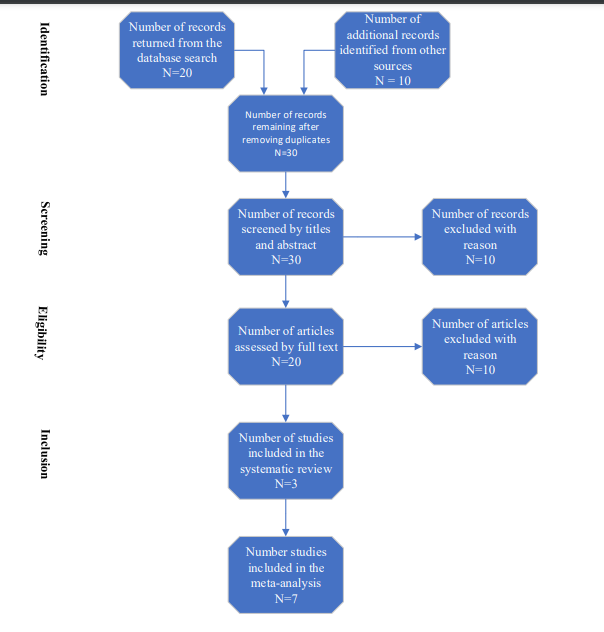
The first stage for identifying articles included keyword data search, focusing on inter-professional engagement and positive health outcomes. The primary databases used were PubMed, QMU, Sage Journals, and Google Scholar, where 30 articles were found. The articles were then screened through a skimming process, and none were found to be duplicates. However, when titles and abstracts were examined in the journals, ten sources were excluded, considering the findings were irrelevant to the research. In addition, ten articles were also excluded, considering that they were published before 2020 and earlier and thus outdated. Therefore, the total number of articles used for the study was ten after the assessment revealed that only a few articles were eligible to be included in the study.