
The Connection Between Force and Motion
The Difference between Velocity and Acceleration
Velocity and acceleration are both used to describe the motion of objects. However, they focus on different aspects of the motion. Velocity describes how fast an object is moving and in what direction. It describes two things: the speed at which an object is moving and the direction of that movement; thus, it is a vector quantity, which is represented mathematically by the formula: velocity = change in position /change in time.
Acceleration, on the other hand, describes how an object’s velocity changes with respect to time. It occurs when an object speeds up, slows down, or changes its direction of movement. Acceleration is represented mathematically by the formula: acceleration = change in velocity/change in time.
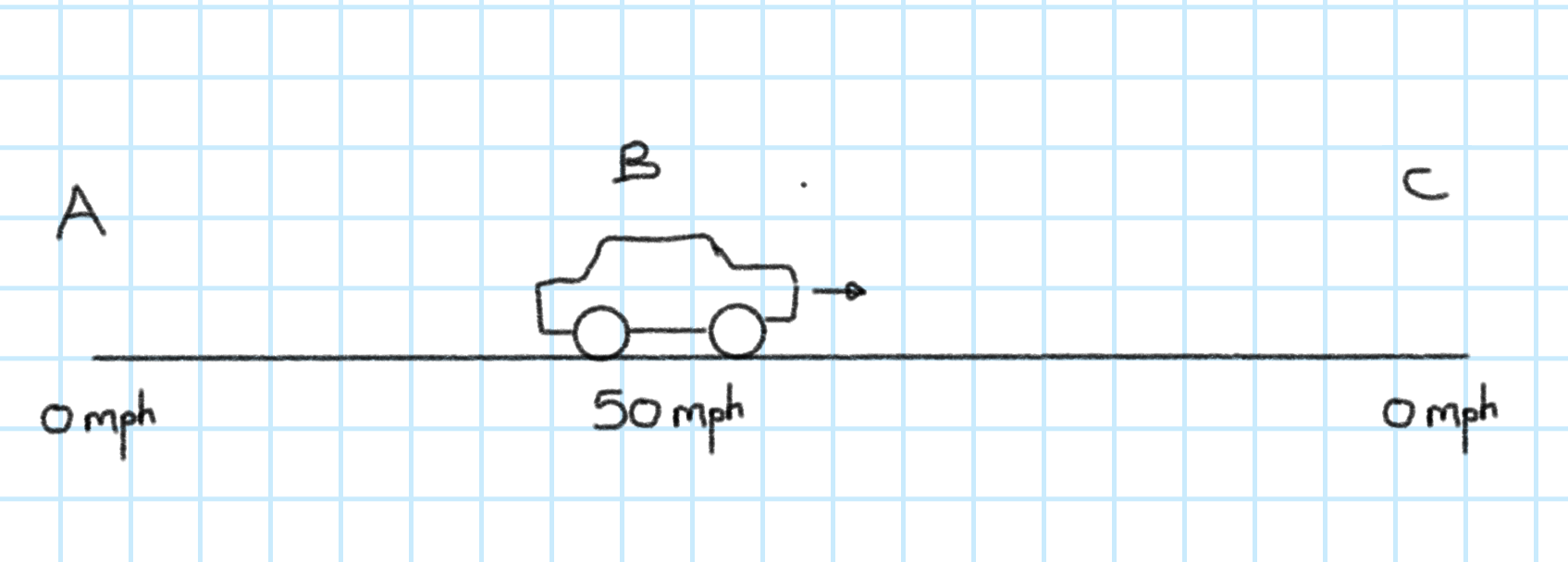
In the illustration below, the car is moving from point A to point C via point B. At point A, it was at rest, and at point C, it will be at rest. We can calculate the car’s velocity by finding how long it took to travel from point A to point C. The velocity will always be a positive number.
The car’s acceleration behaves differently. From point A to B, the car is accelerating, so its acceleration is positive. From point B to C, the vehicle is decelerating; therefore, it has a negative acceleration.
Newton’s Laws of Motion and Their Implications
Newton’s laws of motion are a set of principles that explain the relationship between the motion of objects and the forces acting on them. They are:
First Law: The Law of Inertia
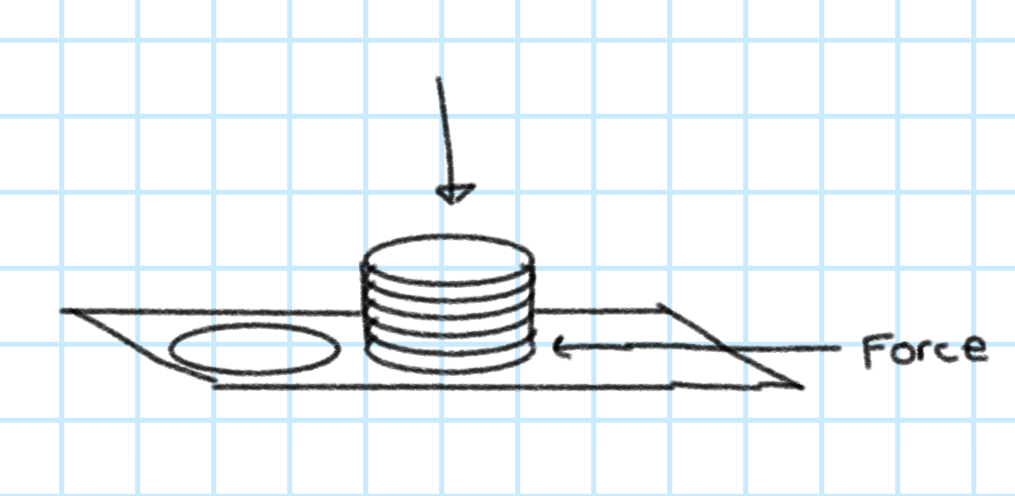
A body will remain in its state of rest or continue to move at a constant velocity unless acted upon by an external force. This law asserts that an object will resist changes in motion (Rahmawati et al., 2021). For instance, if a set of coins is stacked on top of each other, they will remain motionless unless someone moves them. When the coin at the base is struck hard, the coin is removed from the stack, but the rest of the coins remain standing in the same position.
Second Law: The Law of Acceleration
The rate of change of the momentum of a body is directly proportional to the resultant external force producing the change and takes place in the direction of the force. Essentially, it asserts that the force acting on an object is directly proportional to the object’s mass and the acceleration produced by the moving force (Monteiro et al., 2020). The law essentially means that when a force is applied to an object, if the object moves, the magnitude of the resultant acceleration depends on the amount of force applied and the object’s mass.
Third Law: The Action-Reaction Law
For every action, there is an equal and opposite reaction force. This law asserts that forces occur in pairs. When object A exerts a force on object B, object B exerts an equal and opposite force on object A. This force is called the reaction force. Take, for instance, a swimmer trying to propel himself forward. When the swimmer pushes against the wall, the wall exerts an equal and opposite force against the swimmer. This force is what propels the swimmer forward.
Conservation of Energy and Momentum
Different Forms that Energy Can Take
Energy is the ability to do work and manifests in various forms. These are:
- Chemical energy – this is energy that is stored within the chemical bonds of atoms and molecules in chemical substances. This energy is either released or absorbed during chemical reactions.
- Thermal energy – also known as heat energy. The energy results from the collision of particles moving in random motion. It is associated with an object’s temperature.
- Electrical energy is the energy associated with the movement of charged particles through a conductor.
- Nuclear energy – energy released by nuclear reactions. It can be from the splitting of the nucleus (nuclear fission) or the combining of the nucleus (fusion).
Principle of Conservation of Energy and Its Implications
The principle of conservation of energy states that the total energy of a closed system remains constant over time, regardless of any transformations or interactions within it. In other words, energy cannot be created or destroyed; it can only change forms or be transferred from one object or system to another (Chavas, 2024). The principle is closely related to efficiency. The efficiency of a system is the percentage of energy it can transform from one form to another. Since energy cannot be created and machines are never 100% efficient, the relationship between the two explains why a system always takes in more energy than it produces.
Momentum and the Law of Conservation of Momentum
Momentum describes the energy of a moving object, which makes it resistant to changes in its motion. The law of conservation of momentum states that the total momentum of a closed system remains constant if no external forces act on it. In other words, without external forces, the total momentum before a collision or interaction equals the total momentum after the collision or interaction (Xu et al., 2020).
This law is based on the principle of energy conservation. An example of this is the use of a swinging wrecking ball to demolish a structure. When the ball is swung, it gains momentum. On collision, all the kinetic energy in the ball is transferred to the object being hit.
The Concepts and Vocabulary of Wave Motion
Terms Commonly Used to Describe Waves
Waves have several properties that can be used to describe them. These include:
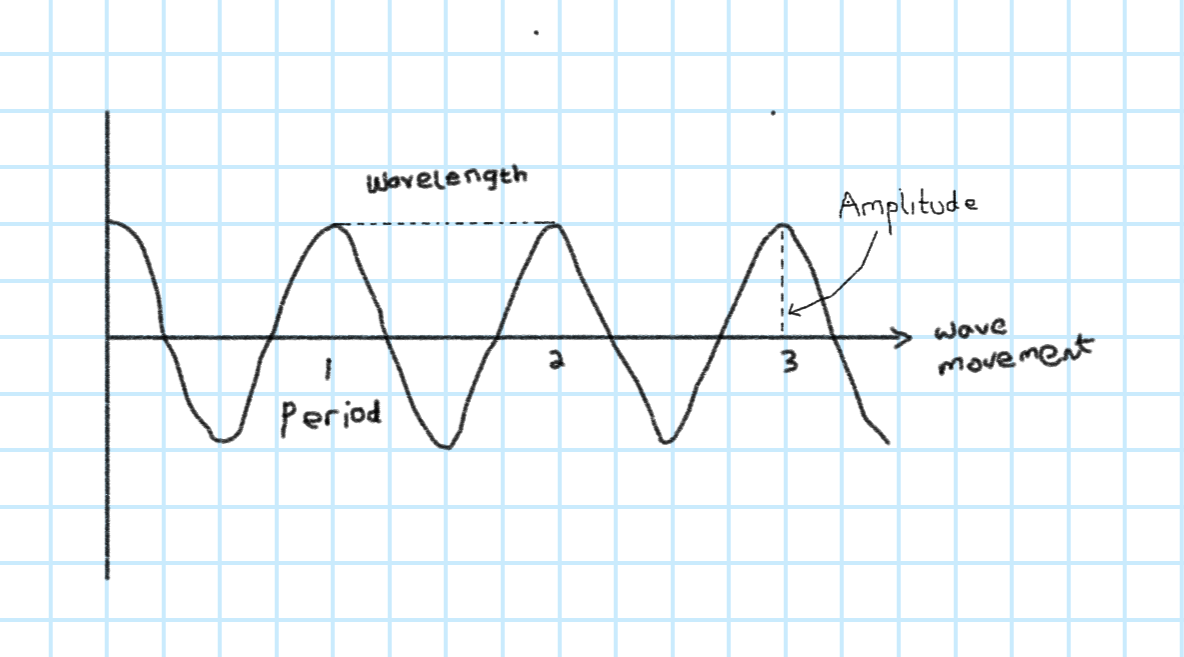
- Amplitude – a measure of the maximum displacement of the wave from its equilibrium to its crest or trough, as illustrated below.
- Wavelength – the distance between two points on the wave that are in phase. It is usually determined by measuring the distance between successive crests or troughs.
- Frequency – a measure of the number of oscillations that pass a fixed point in one second. It is measured in hertz (Hz).
- Period – This is a measure of the time it takes for one complete wave cycle to pass a fixed point.
- Velocity – a measure of the speed at which a wave travels through a given medium.
The Difference Between a Transverse and a Longitudinal Wave
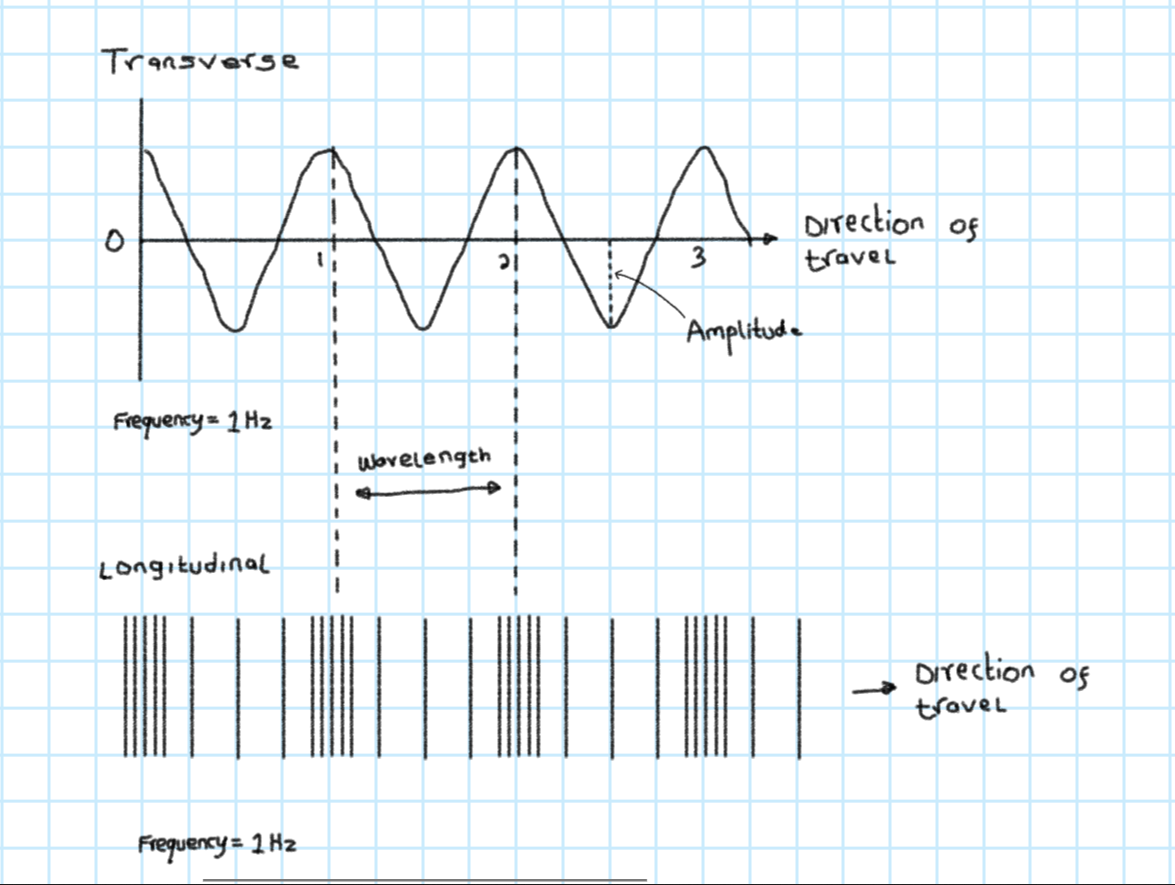
In transverse waves, particles of the medium oscillate perpendicular to the direction of the propagation of the wave. A common example of a transverse wave is an electromagnetic wave. In longitudinal waves, however, the oscillation of the particles of the medium is parallel to the direction of propagation of the wave. An example of a longitudinal wave is sound waves.
Reflection, Refraction, and Diffraction of Water and Sound Waves
Reflection occurs when a wave strikes a surface and bounces back. Both sound and water waves will be reflected when they encounter an obstacle. The reflected wave bounces off the reflecting surface to the same degree as the incident wave that struck the surface.
Refraction occurs when a wave moves from one medium to another, changing its speed and, consequently, its direction. For instance, when sound waves move from layers of air with different temperatures, they are refracted.
Diffraction occurs when waves encounter an obstacle and bend around that obstacle. An example is a sound from one room bending around the door opening to be heard in a different room.
The Straight-Line Model of the Behavior of Light
The Laws of Reflection and Their Use
The laws of reflection describe the behavior of light once it strikes a reflective surface. The two primary laws of reflection are:
- The incidence ray, the reflected ray, and the normal ray all lie on the same plane at the point of incidence.
- The angle of incidence is equal to the angle of reflection.
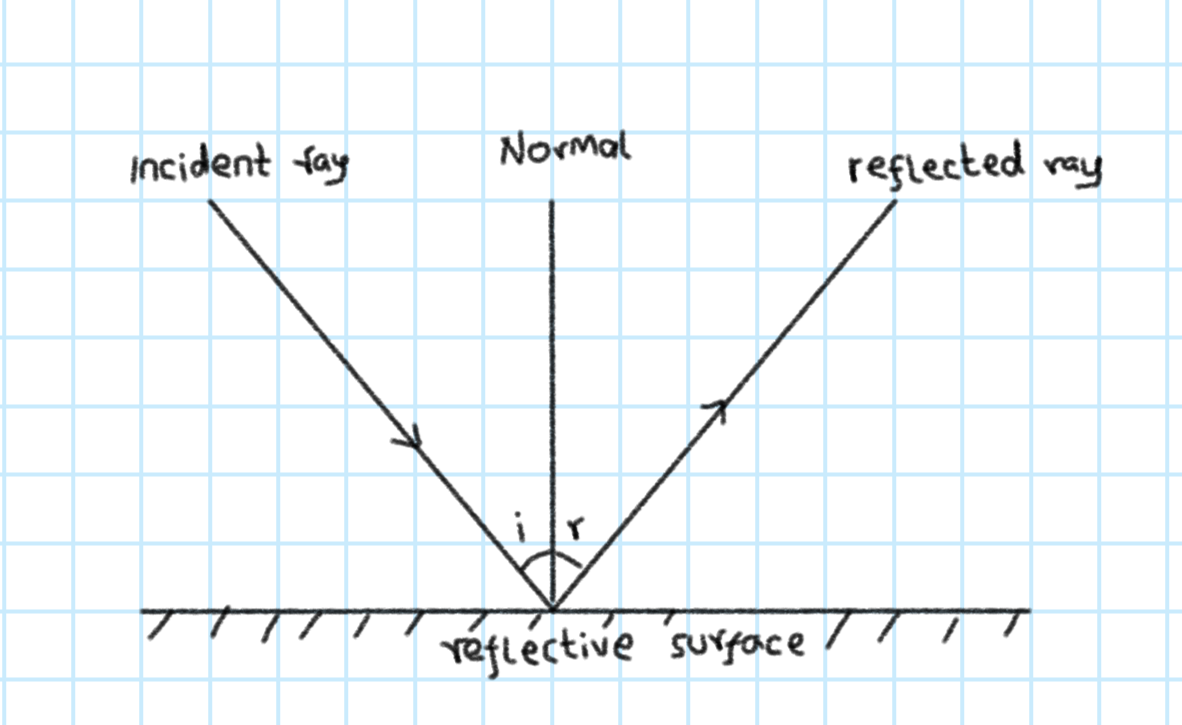
The laws of reflection have many applications, including the making of periscopes.
Refraction
The laws of refraction explain how light changes direction as it passes from one medium to another with a different optical density. The two primary laws of refraction are:
- The ratio of the sine of the angle of incidence to the sine of the angle of refraction is equal to the ratio of the velocities of light in the two media and the ratio of the indices of refraction of the two media.
- The incident ray, the refracted ray, and the normal to the interface between the two media all lie in the same plane.
Conditions Necessary for Total Internal Reflection and Its Use
Total internal reflection occurs when light traveling in a denser medium strikes the boundary between that medium and a less dense medium at an angle greater than the critical angle (Prasad, 2023). An example of the total internal reflection phenomenon is in optical fibers used in telecommunication. Light is injected into the fiber’s core on one end of the fiber at an angle greater than the critical angle. The light travels through the denser core of the fiber, bouncing off its inner walls. This ensures that signals remain confined within the fiber, enhancing transmission efficiency.
Magnets, Magnetic Fields, Electric Charge, and Electric Current
Nature of Magnetism and its Laws
Magnetism is a fundamental force of nature that results from the movement of electric charges within the atoms of an element. It manifests as a force of either attraction or repulsion to objects with magnetic properties.
Properties and Laws of Magnetism
Magnetic poles: Every magnet has two poles, the North and the South Pole. Like poles of different magnets repel, while unlike poles attract.
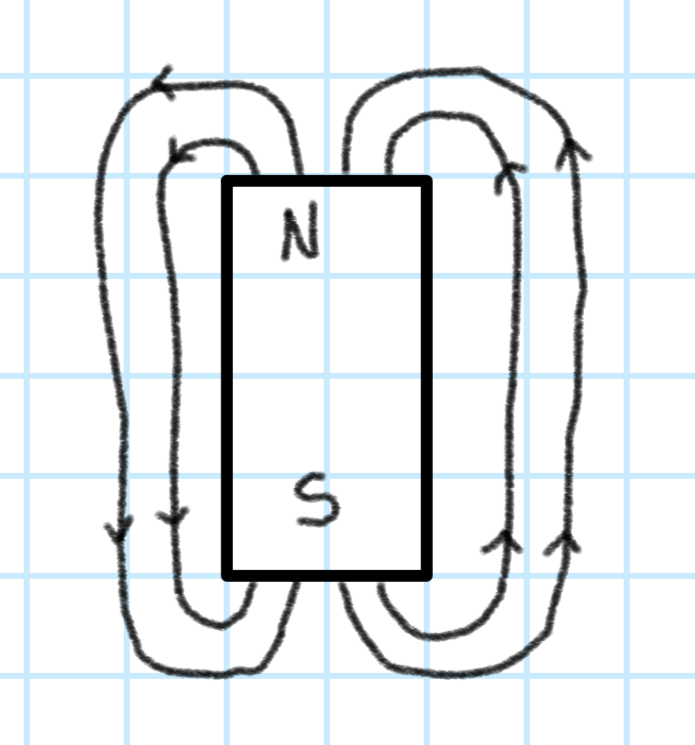
Magnetic fields: Magnets produce a magnetic field around them, emanating from the North Pole to the South Pole. These fields exert a force on magnetic materials, either pulling them toward or repelling them away from.
Magnetic Field Around a Bar Magnet, a Current-Carrying Wire, and A Solenoid
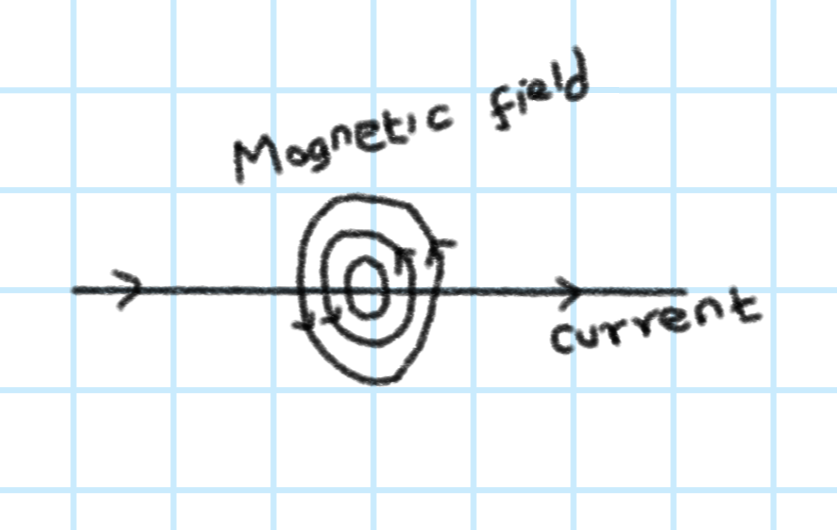
The direction of the magnetic field around a current-carrying conductor can be determined using Fleming’s right-hand grip rule, which states. If a conductor carrying current is grasped in the right hand with the thumb pointing along the wire in the direction of the current flow, the fingers will point in the direction of the magnetic field.
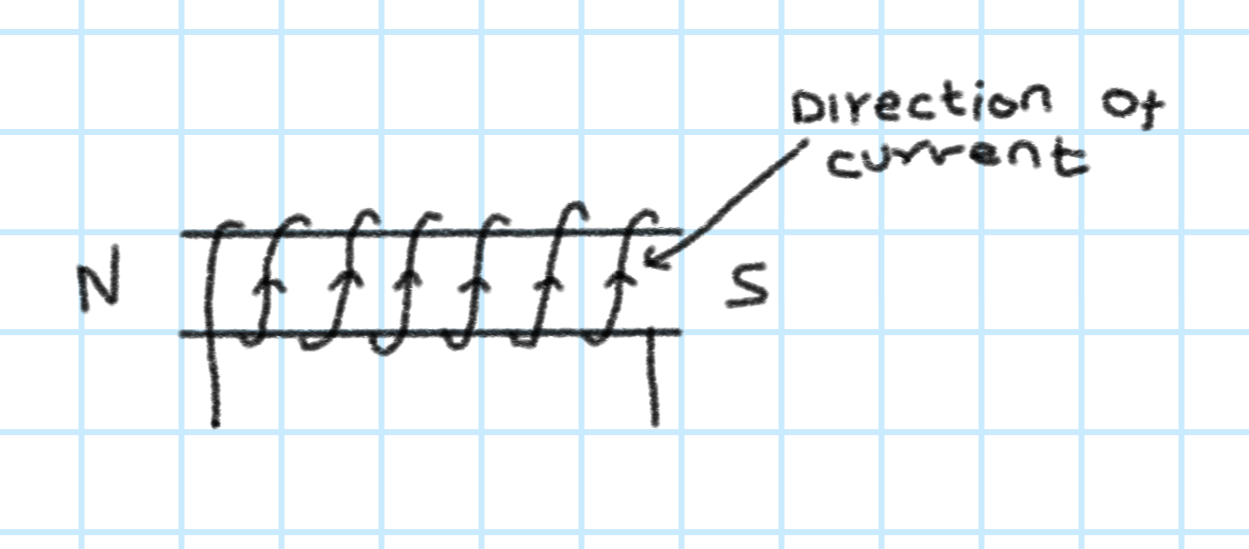
The North Pole and the South Pole in a solenoid are determined using the Right-hand grip rule, which states that if a coil carrying current is grasped in the right hand such that the fingers point in the direction of the current in the coil, then the thumb points in the direction of the North Pole.
Current, Potential Difference, and Their Behavior in Circuits
Current is a measure of the flow of electric charge through a conductor over some time. It is measured in amperes (A). On the other hand, potential difference (Voltage) measures the difference in electric potential between two points in a circuit and is measured in Volts.
In a series circuit, the current remains constant throughout the circuit, while the voltage equals the sum of the individual voltages across each component.
The circuit’s total current is obtained in parallel circuits by summing up the current across each circuit component. However, the potential difference in a parallel circuit remains the same and does not increase with the number of components.
Summary
The work has explored various concepts in physics. Different examples provided explain how understanding concepts such as the relationship between forces and motion is essential in the physical world. When physicists are equipped with knowledge of current and voltage behavior in systems, they should be able to properly evaluate the energy consumption of devices before connecting them to a power supply. This facet serves as a precautionary measure to avoid damage to systems. Moreover, the knowledge triggers a deeper exploration of technological advancements and physical phenomena.
Reference List
Chavas, J.-P. (2024) ‘On the conservation of energy: Noether’s theorem revisited,’ Heliyon.
Monteiro, F. et al. (2020) ‘Force and acceleration sensing with optically levitated nanogram masses at microkelvin temperatures‘, Physical Review A, 101(5).
Prasad, R. (2023) ‘Optical fiber communication‘, Physics and Technology for Engineers, pp. 347–376.
Rahmawati, E. et al. (2021) ‘Analysis of physics concept of Newton’s laws on the Dadhak Merak Dance in the reogponorogo Cultural Arts‘, Journal of Physics: Conference Series, 1832(1).
Xu, W. et al. (2020) ‘Assessment of Knowledge Integration in student learning of momentum‘, Physical Review Physics Education Research, 16(1).