
Introduction
Singapore’s economy reflects the country’s situation, which heavily depends on world trade and is regarded as a significant player in the world economy. The reasons for selecting Singapore for this work are its port, advanced technology, and the diversity of its people. Furthermore, examining the interdependence among expansion, inflation, and labor force complexity highlights the economic journal’s impact. This work aims to provide an empirical and critical analysis of Singapore’s economy. The report will examine reputable data sources and economic theory and present an adequate understanding of the economy’s performance.
Findings
Nominal GDP and Real GDP
Real and nominal GDP are metrics of economic growth that reflect a country’s overall economic performance. Because nominal GDP is the overall market value of goods and services generated within a country’s borders over a specific period, it does not account for inflation. Conversely, real GDP is adjusted for inflation and provides a more accurate depiction of economic growth.
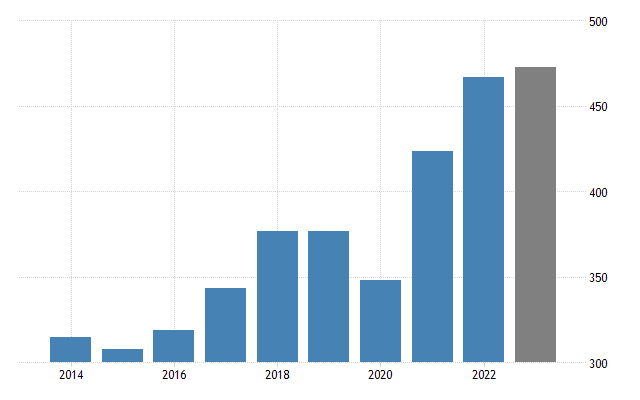
Singapore can be considered an example, as its real GDP, projected for 2022 at $609.002 billion, testifies to the country’s solid economic performance in industry (“Singapore,” 2024). The chart highlights Singapore’s advantages in trade and services, including its strategic location and stable business environment. As shown in image 1 below, GDP rose significantly from 2014 to 2022 (Trading Economics, 2019). The steady rise in the GDP provides evidence of the consistent, stable trading environment in Singapore.
Entrepreneurial real GDP provides a broader picture of Singapore’s economic development than a common one. Nevertheless, fluctuations in the global economy do not affect Singapore; sectors such as finance, manufacturing, and technology drive Singapore’s growth. The ability to withstand economic challenges and adapt to changing economic conditions is one of the factors that demonstrate Singapore’s capacity to achieve sustainable growth.
The commanding role of nominal and real GDP measurements in macroeconomics is undeniable. Nominal GDP is opposite to real GDP, which accounts for changes in the size of the economy and gives an accurate idea of the economy (“Singapore,” 2024). Complementing each other, these signals show that the country is in a perfect economic position, has a stable environment, and is an attractive investment destination, thereby making Singapore a formidable competitor in international investment.
Growth Rate
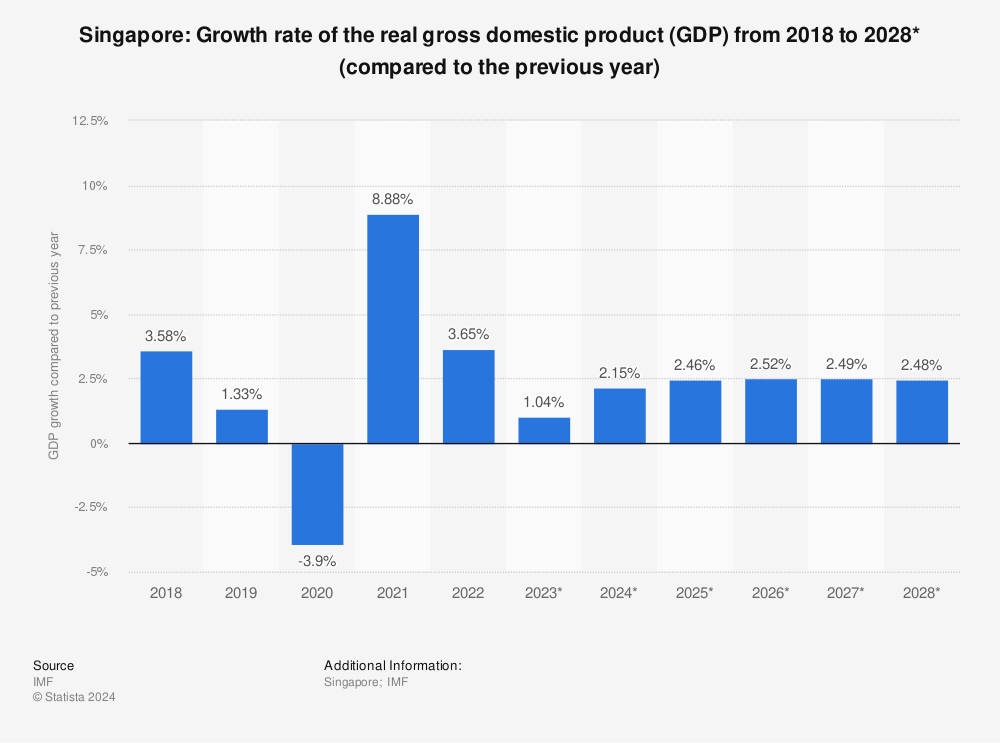
The growth rate is the fundamental economic indicator that measures the change in a country’s real GDP over a given period, usually annually. In Singapore, the growth rate signifies the speed at which the nation’s economy expands. This provides insights into its overall economic well-being and output. Singapore has consistently created favorable growth rates, averaging around 3.65% percent annually (“Singapore,” 2024).
Image 2 below shows the graph indicating both the annual growth rate and projected GDP through 2028. While Singapore’s highest growth rate was recorded in 2021, the current rate is 2.15%, a slight rise from 2022 (O’Neill, 2023). This consistent growth trend results from comprehensive investments in infrastructure, technology, and human resources. Besides critical sectors such as finance, manufacturing, logistics, and information technology, which drive the country’s economic growth, these sectors also foster innovation, productivity, and competitiveness.
A higher growth rate implies more economic activity and higher living standards for Singaporeans. Additionally, this factor symbolizes the nation’s endurance to external financial shocks and ability to effectively adjust to changing market conditions. The fast-growing economy attracts foreign investment, boosts business confidence, and positions Singapore as a regional economic leader (“Singapore,” 2024). Nevertheless, this growth should be driven by innovative approaches, new products and services, talent development, and business conditions that promote competitiveness to support long-term economic sustainability.
Inflation Rate
The inflation rate is an important economic indicator representing the percentage change in the total price level of all items, including services produced within the economy. In Singapore, the inflation rate is typically 6.1, indicating stable, well-managed prices (“Singapore,” 2024). A moderate inflation rate is considered an indicator of economic stability and a factor that contributes to increasing demand, business confidence, and overall financial performance. It inherently induces people to invest and spend, therefore boosting economic activity without inflating the cost of living, which would lead to a decline in the standard of living.
Singapore’s monetary stability is the result of sound economic policies, supply chain management strategies, and market-governing laws. The regulated inflation scenario helps consumers restore their confidence, provides them with longer-term plans and investment options, and contributes to stable economic growth (“Singapore,” 2024). On top of that, a low and stable inflation rate improves the efficiency of monetary policy instruments, enabling central banks to better manage interest rates and the money supply by using various tools to maintain price stability, reduce unemployment, and support sustainable economic growth.
Unemployment Rate and Participation Rate
The unemployment rate and employment levels are the two key metrics in labor market dynamics: the economy’s condition and resilience. Singapore typically experiences a low unemployment rate, which reflects a robust labor market with many job opportunities, averaging around 3.59% (“Singapore,” 2024). The heterogeneous economy, the professional structure of the workforce, and the active policies in the state’s labor market cause this low unemployment rate. In addition, the participation rate, the ratio of working-age people actively contributing to the labor market, is a critical aspect. Singapore has a high participation rate, reflecting a strong work attitude and worker engagement across different industries throughout the economy.
However, structural unemployment and skills mismatch persist as extensive problems. Therefore, the work in skill development, education, and training programs must never be interrupted. Furthermore, demographic transitions, technological evolution, and international market adaptations demonstrate the necessity of flexible workforce policies to keep the Singapore labor force flexible, inclusive, and competent on the global stage(“Singapore,” 2024). On top of that, such a high level of participation calls for an increase in the labor force, which leads to higher productivity, economic growth, and social harmony.
Connection Between Growth Rate and Inflation Rate
A complex and comprehensive relationship underlies the relationship between the inflation rate and the economic growth rate, affecting financial stability, monetary policy, and consumer behavior. A well-controlled inflation rate is often coupled with steady economic growth in Singapore, reflecting the right balance (“Singapore,” 2024). If the economy maintains a circular growth pattern, more companies will expand, and people will be looking for goods and services to buy. As a result, more people will get jobs to earn a living. It may also lead to a lower inflation rate, keeping product and service prices down despite increased consumer demand.
Conversely, accelerated economic growth would be subject to inflationary pressures if demand exceeded supply, raising prices. Central banks typically use several monetary policy tools, adjusting interest rates to fight inflation and maintain price stability, thereby supporting the country’s economic growth (“Singapore,” 2024). Learning about the determinants of expansion and inflation requires understanding economic principles, financial trends, and market conditions. This endeavor calls for finesse to balance the prompt sustainable growth, preserve price stability, and secure an economic climate where consumers are comfortable buying goods and services in the long term.
Current Labor Market
Singapore’s workforce is diverse and can be divided into the following groups: well-educated migrant workers and a relatively new group comprising freelancers and gig economy participants. Unemployment has three forms: transitional, structural, and cyclical, which might produce unemployment (“Singapore,” 2024). The culturally diverse mix of nationals and foreigners in the workforce shapes creativity and helps productivity flourish. On the one hand, demographic aging, digital disruption, and global competition point to the profound reshaping of the workplaces and the constant need for investment in organizations’ human capital.
Conclusion
Multiple factors have already proven to be resilient, innovative, and adaptable in the Singapore economy. We prove that significant economic components, such as economic growth, inflation, and labor market dynamics, are interconnected, as revealed by more detailed analysis. The fact that Singapore has recorded sustained economic growth, stable prices, and labor market dynamism reminds the world that the country is a power in the international financial arena. The challenges and opportunities will drive Singapore’s economy to scale up, provided that strategic policymaking, workforce investment, and the development of a socially inclusive economy drive economic growth.
References
O’Neill, A. (2023). Singapore – Gross domestic product (GDP) growth rate 2022 | Statistic. Statista; Statista.
Singapore. (2024). The World Factbook.
Trading Economics. (2019). Singapore GDP. Tradingeconomics.com; trading economics.